
Latest news
Read the latest news from the Centre for Sustainable Materials Research and Technology


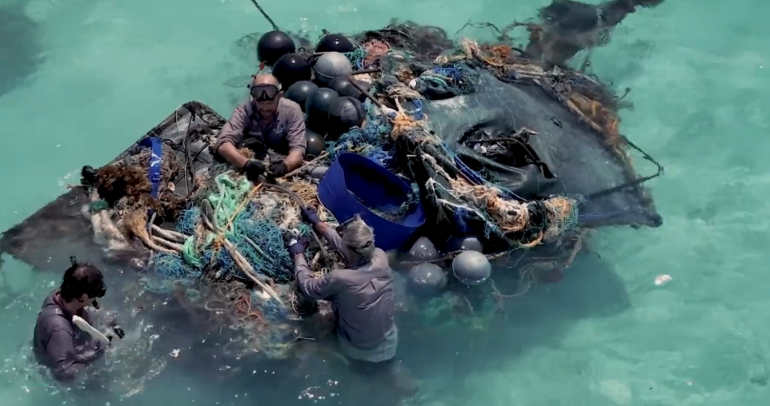
UNSW SMaRT Centre researchers are collaborating with communities and Indigenous leaders in the northern Australia about solutions for the fight against discarded ‘ghost’ nets and other fishing marine debris.
SMaRT's various MICROfactorieTM Technologies are able to use waste plastics and other waste and reform them into filament for 3D printing and products and other feedstocks for remanufacturing.
Under the National Environmental Science Program’s Sustainable Communities and Waste Hub which SMaRT and its Director, Prof Veena lead, the researchers have been working directly with communities in northern Australia in recent times, building a detailed understanding of the types, sources and characteristics of marine plastic waste and using this evidence to co-design solutions that respond to local realities.
Marine debris in the Gulf of Carpentaria is a complex challenge shaped by ocean currents, seasonal winds and proximity to international waters.
Ghost nets and other plastic waste are carried into the Gulf during the monsoon, then concentrated along remote coastlines where communities are left to manage the impacts.
This video highlights how the Sustainable Communities and Waste Hub is supporting research aimed at delivering practical outcomes and lasting impact.
The SMaRT Centre has previously done research with a partner on devising ghost net solutions work in 2021 and 2022, in work commissioned by the federal Department of Environment (see background below).
Through collaboration with communities and partners, the SMaRT researchers through the Hub are helping to identify pathways to turn recovered plastic into useful products through regionally based remanufacturing that is fit for purpose.
This approach creates environmental benefits by reducing marine pollution while also supporting social and economic outcomes for communities.
By focusing on partnership, co-delivery and real-world application, the Sustainable Communities and Waste Hub is translating research into on-the-ground impact, supporting solutions that benefit community and Country now and into the future.
Learn more about the Hub's fit-for-purpose recycling technology research here.
SMaRT Centre background on its previous ghost net solutions work from 2021 and 2022:
UNSW Sydney has issued a media release highlighting a joint report by environmental not-for-profit organisation TierraMar and the UNSW SMaRT Centre for the Australian Department of Environment that outlines solutions for the fight against discarded ‘ghost’ nets and other fishing marine debris in northern Australia.
Sustainable methods to detect, collect, transport and responsibly dispose of ghost nets and other plastic waste in northern Australia are outlined in a report prepared by TierraMar and the UNSW SMaRT Centre.
Commissioned by the Australian Department of Agriculture, Water and the Environment (DAWE), the report will directly inform the investment in new infrastructure and/or coordinated services under the Australian Government’s Ghost Nets Initiative.
“Ghost nets are fishing nets that have been lost at sea, abandoned or discarded when they have become damaged,” explains Founding Director of the UNSW SMaRT Centre, Professor Veena Sahajwalla.
“Discarded fishing equipment can cause pollution such as microplastics and entangle marine wildlife and damage reefs, silently killing.”
The currents and conditions in the Arafura and Timor Seas and the Torres Strait mean that marine debris accumulates in the Gulf of Carpentaria off northern Australia, recognised as a global marine debris ‘hot spot’.
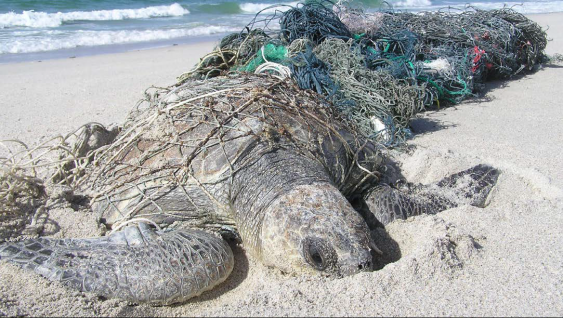
Olive Ridley turtle caught in ghost nets. Photo: Jane Dermer.
“It is imperative that we address the issue of marine waste in this region. Four of the six marine turtle species found in Australian waters are listed as threatened under Australian environmental legislation and they are regularly found entangled in derelict fishing nets,” Prof. Sahajwalla said.

Professor Veena Sahajwalla. Photo: Salty Dingo.
The report jointly prepared by the UNSW SMaRT Centre and TierraMar provides guidance to inform investment in new infrastructure and coordinated services for northern Australia. The work was undertaken using a combination of desktop research, materials analysis, and stakeholder consultation with government, community, industry, and non-government organisation stakeholders.
“There is an opportunity to develop a range of high-quality homeware and building products made directly from ghost nets and marine debris coming out of northern Australia. The products, such as ceramic tiles, could creatively reflect the unique cultures, artistic values and connections to country by local communities,” said Prof. Sahajwalla.
“The homewares and building product could be produced using proven MICROfactorieTM ‘waste to product’ technologies for re-manufacturing.”
To address the challenge of ghost nets, especially in the Gulf of Carpentaria, the Australian Government is implementing the Ghost Net Initiative until June 2024.
Read more and to download the report