Latest news
Read the latest news from the Centre for Sustainable Materials Research and Technology


UNSW SMaRT Centre recently joined leaders and decision makers in Far North Queensland for a range of meetings and discussions about innovative waste and recycling technologies and creating localised circular economies.
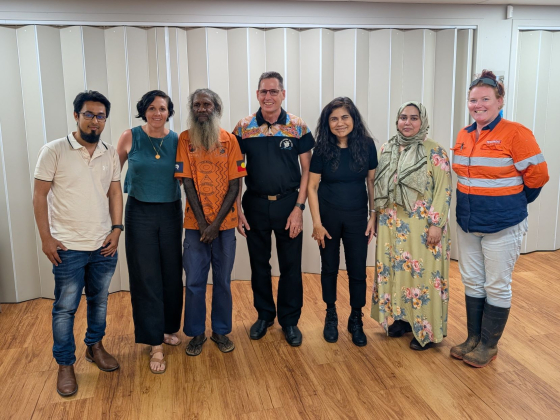
SMaRT Director, Prof Veena Sahajwalla and Researcher and Lecturer Dr Rumana Hossain joined representatives of the Western Cape Chamber of Commerce, Aurukun Shire Council, Mapoon Aboriginal Shire Council, Napranum Aboriginal Shire Council, the Weipa Town Authority, James Cook University, the Torres and Cape Indigenous Council Alliance, Western Cape Communities Trust.
The discussions are looking to establish projects under the National Environmental Science Program’s Sustainable Communities and Waste Hub, which Veena and the UNSW SMaRT Centre lead, under the Hub's Fit for Purpose Technological Recycling Solutions project stream.
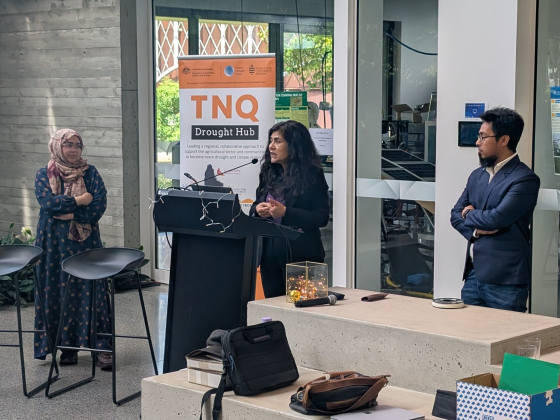
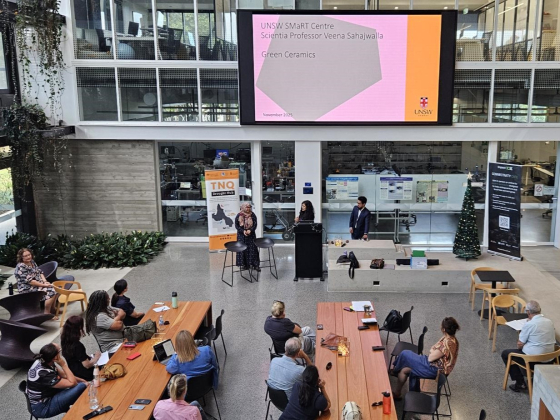
Veena was welcomed by the Tropical North Queensland Drought Resilience Adoption and Innovation Hub (TNQ Drought Hub) for a Knowledge Exchange Forum at James Cook University Ideas Lab in Cairns and did a tour of the Western cape region, where she also visited in early 2025.
The Forum focused on SMaRT's various MICROfactorieTM Technologies and explored key issues and opportunities related to plastics recycling and circular economy pathways in Far North Queensland, and to enable knowledge sharing between SMaRT and local stakeholders.
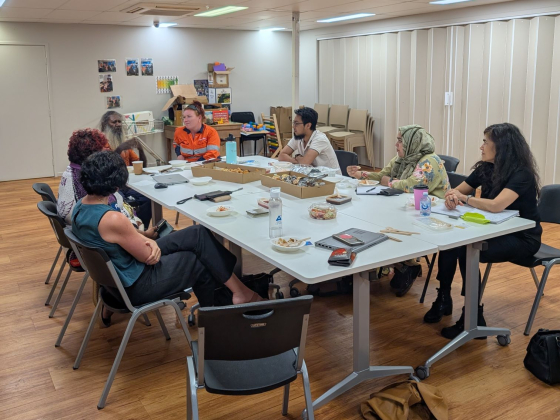
Talks focused on challenges relating to recycling and resource recovery in regional contexts, innovative, decentralised solutions such as MICROfactorieTM Technologies and collaborative opportunities and potential regional applications.
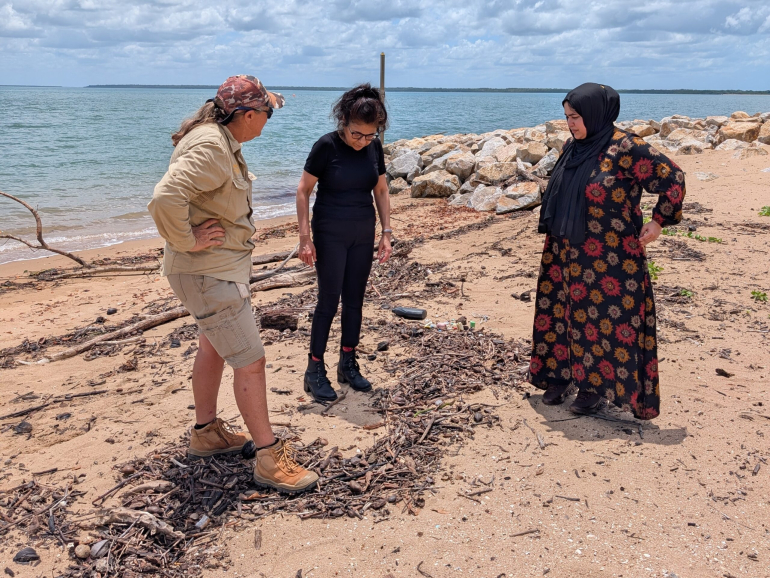
Kelli Leatham (Executive Manager Environmental Services Mapoon Aboriginal Shire Council), Veena Sahajwalla and Rumana Hossain. All images by Jen McHugh
The forum has seen local councils, government departments, business owners and researchers join together to share knowledge.
Veena said: “The tyranny of distance is a constant reality in FNQ, which creates a number of logistical challenges, but models encompassing circular economies that move beyond the reliance of economies of scale, we can unlock opportunities sin our region.
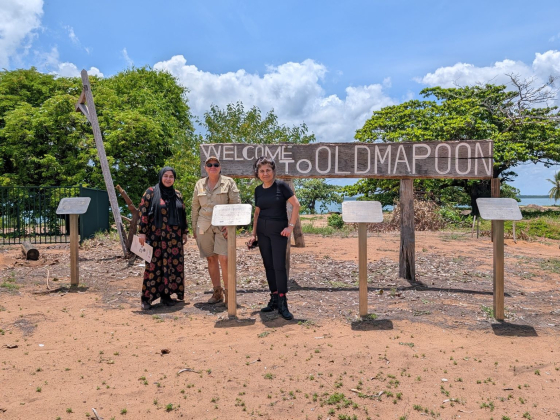
In Mapoon, Professor Sahajwalla and Dr Rumana Hossain witnessed firsthand the significant impact of marine debris on the community and surrounding environment. The SMaRT Centre team also gained insight into regional challenges associated with mine closures during a tour of Rio Tinto operations.
Professor Sahajwalla's interest in the region was sparked by her attendance of the Western Cape Futures Symposium of which the TNQ Hub is a partner and is off the back of her National Press Club address in late October where she talked about her vision for a sustainable future using waste as a resource via innovative technologies.
TNQ Hub said: "By brining Professor Sahajwalla and her team to the region, we hope to offer real sustainable economic opportunities for people living in remote locations and work towards solving waste issues that can sometimes feel insurmountable."
Part of Veena's talks highlighted that using recycling innovations such as UNSW SMaRT Centre's MICROfactorieTM Technologies and its Green SteelTM Polymer Injection Technology that recover valuable materials from waste and reform them into new manufacturing feedstock and products are central to help achieve the sustainability needed for the future.
She highlighted SMaRT's work on researching solutions for the fight against discarded ‘ghost’ nets and other fishing marine debris in northern Australia.