
Latest news
Read the latest news from the Centre for Sustainable Materials Research and Technology


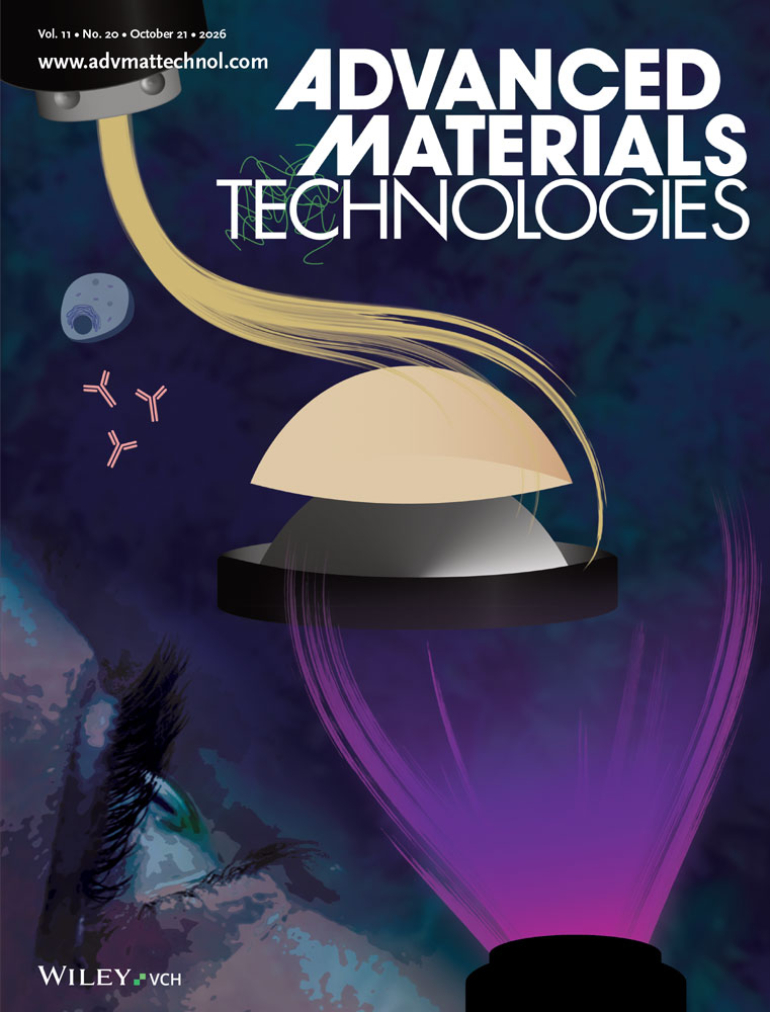
A published UNSW SMaRT Centre research study demonstrates that SMaRT's "microrecycling" methods can recover valuable copper nano-particles from waste computer circuit boards usually destined for landfill and stockpiles.
The research - published in Wiley's Advanced Materials Technologies scientific journal, carried out under and funded by SMaRT's ARC Industry Laureate Fellowship for Green Metals - addresses the growing challenge of electronic waste by demonstrating how materials that would normally be discarded can be transformed into useful nanomaterials through a thermal upcycling process.
The research builds on a growing body of work by SMaRT including recovering essential metals from waste solar cells and research that revealed a novel method to separate glass layering in waste solar photovoltaic (PV) panels.
Flexible printed circuit boards (FPCBs) are increasingly used in modern electronics such as wearable devices, medical equipment, and compact consumer products.
These circuits contain significant amounts of copper embedded within layers of plastic and other materials, making recycling difficult using conventional methods.
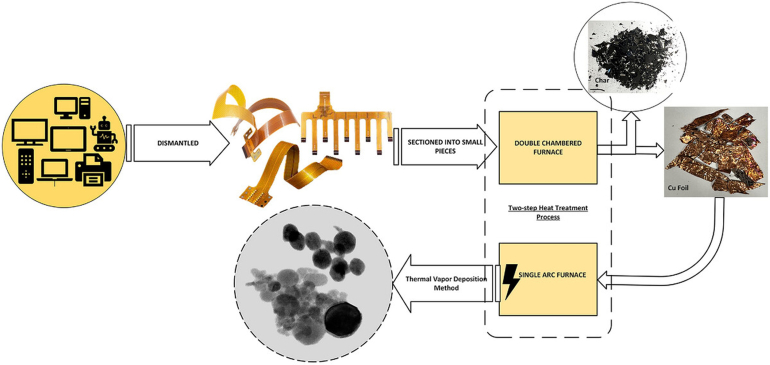
Image: Two‐Step Thermal Upcycling of Flexible Printed Circuit Board Waste Into Metallic Copper Nanoparticles: Synthesis and Characterisation
In this study, SMaRT authors developed a two-step thermal treatment designed to separate and recover the copper efficiently without relying on chemical extraction processes.
In the first step, waste FPCBs were heated to about 700°C. This temperature was sufficient to break down and remove the polymer components surrounding the copper.
In the second step, the recovered copper-rich material was exposed to an extremely high-temperature arc discharge process at approximately 2600°C. Under these conditions, the copper vaporised and then condensed into nanoparticles.
The resulting copper nanoparticles were predominantly spherical in shape and generally smaller than 100 nanometres in diameter.
Detailed characterisation showed that the product consisted of approximately 96% copper, with only small amounts of copper oxide present. Microscopic analysis confirmed a highly crystalline structure consistent with metallic copper nanoparticles.
The researchers also examined the physical characteristics of the nanoparticles. They found that the particles tended to cluster together, creating small spaces between particles that contributed to a measured surface area of 7.31 m²/g.
Importantly, the study clarified that these spaces were caused by particle agglomeration rather than true internal porosity, helping to better understand the material's behaviour and potential applications.
A significant aspect of the work is that the process avoids conventional wet-chemical nanoparticle synthesis methods, which often require large amounts of solvents and chemical reagents.
Instead, the technology relies entirely on thermal processing, making it a potentially cleaner and more sustainable approach for recovering metals from electronic waste.
The broader significance of the study lies in its demonstration of a circular economy approach to e-waste management.
Rather than treating flexible circuit boards as a disposal problem, the process converts them into a valuable advanced material with potential applications in catalysis, electronics, energy technologies, sensors, and other nanotechnology fields.
The authors concluded that thermal upcycling offers a promising pathway for simultaneously reducing electronic waste and producing high-value nanomaterials from urban mining resources.
In simple terms, the paper shows that old flexible circuit boards can be transformed from a difficult-to-recycle waste stream into high-purity copper nanoparticles using a two-stage heating process.
This creates a valuable product while reducing the environmental burden associated with growing volumes of electronic waste.