
Latest news
Read the latest news from the Centre for Sustainable Materials Research and Technology


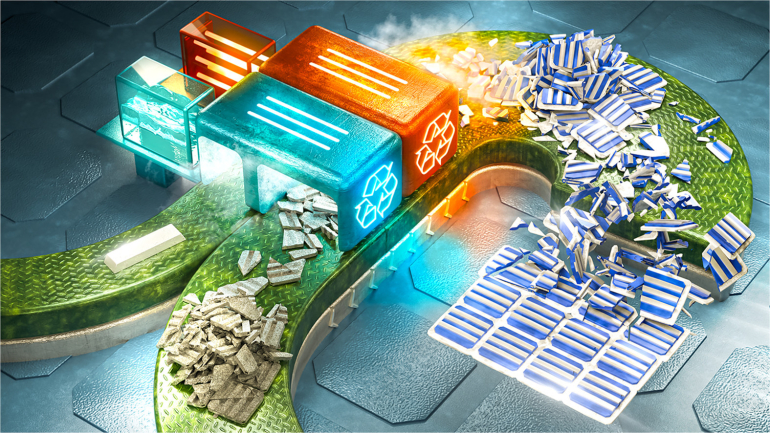
UNSW SMaRT Centre researchers have had published a study revealing a novel method to separate glass layering in waste solar panels.
In a first, the researchers developed a technique to disengage the glass from multi-layered materials embedded in the waste panels, which often go to landfill, waste stockpiles or even incinerators due to a lack of effective and affordable solutions for removing the adhesive between layers.
Published in the scientific Elsevier journal, Waste Management, the study of photovoltaic (PV) waste, carried out under and funded by SMaRT's ARC Industry Laureate Fellowship for Green Metals, found:
This novel, efficient method for disengagement of glass from the rest of the module used water under high pressure and relatively low temperatures in a hydrothermal reactor, allowing for facile separation of the glass from the interlayer.
The other layers of the module could also be easily be peeled apart in subsequent processes.
Crucially, the separated glass was free of metals and polymers, so it could be utilised directly for further applications as a feedstock for remanufacturing.
The benefits of this method include no use of chemicals, preservation of the recovered materials' quality (i.e., interlayers, silicon sheet, and glass), relatively low-temperature operation, no hazardous gas generation, and reduced energy consumption.
A pilot scale design of the method has been proposed for processing a full panel, demonstrating its industrial viability.

The study provides a pilot design plan for future scaling up based on the lab-scale results.
This new method, an innovative solution presented in this research, has been demonstrated to be effective for the efficient disengagement of a variety of PV panel brands.
The optimal conditions for the method have been established by tuning the temperature of the liquid, type of media, volume of liquid in the reactor, and operation time.
The process only requires water as the liquid medium, which can be filtered and reused after each cycle.
These advantages include: