Latest news
Read the latest news from the Centre for Sustainable Materials Research and Technology


A UNSW SMaRT Centre research study published by the Royal Society of Chemistry has found waste coffee powder can be used to recover lithium (Li) and cobalt (Co) from waste batteries.
In yet another discovery for beneficial use of waste coffee grounds as a useful resource, SMaRT has this time found the biomass' use as a "reducing agent" in recovering vital elements from waste Li-ion batteries (LIBs) through a mild temperature pyrometallurgical process that is both cost-effective and environmentally friendly.
In fact, the method deployed by SMaRT found this process is more environmentally friendly and economical because it eliminates the use of strong acids, bases, and solvents compared to current recovery methods.
Additionally, the regenerated Li and Co showed excellent electrochemical performance with very strong charge and discharge capacities respectively. Overall, the proposed biomass-based reduction technique offers a cost-effective and eco-friendly approach to recycling spent LIBs.
The present study also makes a significant contribution to achieving several of the United nation's Sustainable Development Goals (SDGs), specifically SDG 7, SDG 8, SDG 9, SDG 11, SDG 12, SDG 13, and SDG 15. In the future, different types of biomasses could be applied to recycle different types of LIBs containing various types of cathode materials, such as lithium nickel manganese cobalt oxide (LNMCO) and lithium manganese oxide (LMO).
The novel findings, in the new study published by Royal Society of Chemistry's Green Chemistry Journal under its ARC Microrecycling Research Hub, build on other work using waste coffee grounds as sources of hydrogen in its Green Steel Polymer Injection Technology, and as sources of carbon for use in filtration systems.
This study found that to develop sustainable recycling methods for spent LIBs, "the use of renewable materials and minimizing energy consumption are essential.
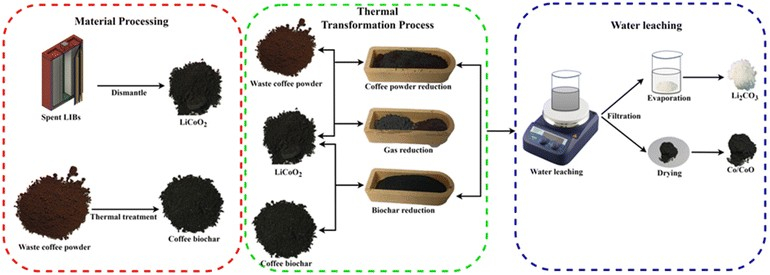
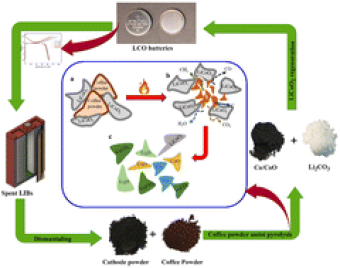
"Here, we propose a biomass-based, energy-intensive reduction method to recover Li and Co from spent LIBs. Waste coffee powder was used as a biomass to provide carbon and reducing gas (hydrogen) during the reduction process. During selective thermal transformation, the carbon and reducing gas derived from waste coffee powder converted the cathode material of LIBs LiCoO2 into Li2CO3 and Co/CoO, recovering 89.23% of Li and 93.27% of Co.
"Compared to the conventional carbothermic reduction process, this transformation occurred at a lower temperature (600 °C) due to the synergetic effect of reducing gas and carbon. Moreover, LiCoO2 was regenerated from the recovered Li2CO3 and Co/CoO, demonstrating excellent electrochemical performances in terms of charge–discharge capacity, cyclic performance, rate performance, EIS, and CV curve analysis. An EverBatt-based environmental and economic analysis shows that this reduction method reduces greenhouse gas (GHS) emissions and energy consumption, making it economically viable. Overall, this research offers an eco-friendly and energy-efficient method to recycle spent LIBs using waste biomass. Additionally, this study will contribute to achieving several Sustainable Development Goals (SDGs).
"Due to their environmental friendliness, high working voltage, rechargeability, high power density and longer lifespan, the use of lithium-ion batteries (LIBs) is increasing daily worldwide. LIBs are playing a vital role in supporting a fuel-free economy, and it is estimated that they contribute about 37% of the global battery market.1 Lithium possesses several advantageous properties, such as a higher heat capacity (3.489 J g−1 mol−1) and higher redox potential (93.045 V) than other metals such as zinc.
"These properties are expected to drive LIBs’ increasing contribution to the battery market in the near future.2 LIBs are used in cellular phones, portable devices, electric vehicles, laptops, medical equipment, and sophisticated electronic devices. Due to their versatile applications, the demand for LIBs has been rising steadily.3 In recent years the production and utilization of electric vehicles have increased significantly which could reduce CO2 emission
"Traditionally, three methods are commonly used for the recovery of waste LIBs, that is hydrometallurgy, pyrometallurgy, and biometallurgy.11 Among these, the hydrometallurgical method is the most widely used and considered the most promising recycling process due to its low impurity content, high leaching efficiency, and selective metal recovery capabilities. Currently, the pyrometallurgy process is considered the most mature recovery technology and is widely used in various industries due to its short operation time, reduced production of liquid waste, and lower raw material requirements.
"The use of H2 as a reducing agent has advantages over carbothermal reduction as it reduces both the operational time and temperature."