Latest news
Read the latest news from the Centre for Sustainable Materials Research and Technology


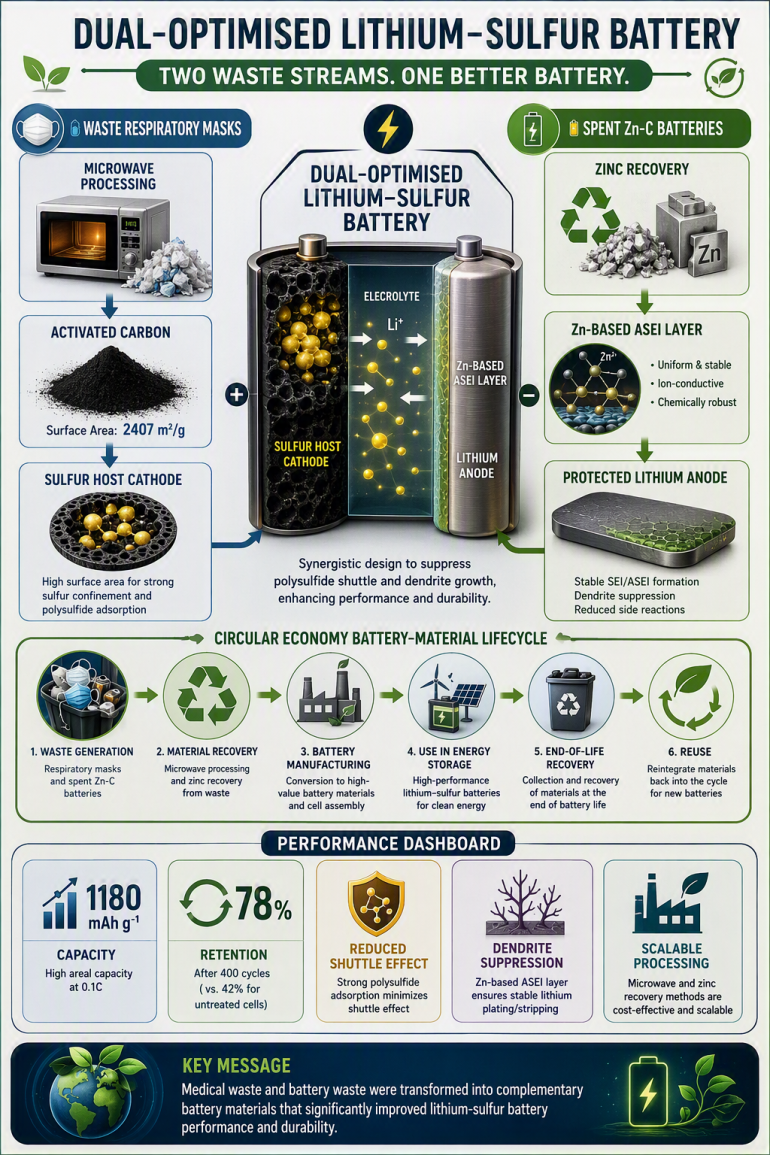
A UNSW SMaRT Centre research study has developed a method of how to recover useful materials from waste face masks and spent batteries to make better new batteries, transforming these wastes into valuable feedstock for remanufacturing.
Published in Elsevier ScienceDirect's Journal of Environmental Chemical Engineering, researchers developed a process to engineer a dual-modified lithium-sulfur battery (Li-S) using the waste materials from respiratory masks and spent batteries.
Li-S batteries are considered one of the most promising next-generation battery technologies because they can potentially store much more energy than conventional lithium-ion batteries. However, two major problems have limited their commercial adoption:
Instead of addressing only one problem, the researchers tackled both challenges simultaneously by modifying both the anode and the cathode using materials made from waste resources.
Waste Stream 1: Used Respiratory Masks
Discarded single-use respiratory masks were converted into activated carbon using a microwave-assisted process. The resulting carbon achieved:
Waste Stream 2: End-of-Life Zn-C Batteries
Zinc recovered from spent zinc-carbon batteries was used to create a protective Zn-based Artificial Solid Electrolyte Interphase (ASEI) on the lithium metal anode. The ASEI layer:
Key Findings
High Battery Capacity - the dual-modified battery achieved:
Excellent Long-Term Stability - after 400 cycles at 0.5C:
Improved Battery Durability -the combined cathode and anode modifications:
Scalable Manufacturing - the researchers used:
Both approaches are relatively simple and scalable for larger-scale production.