
Latest news
Read the latest news from the Centre for Sustainable Materials Research and Technology


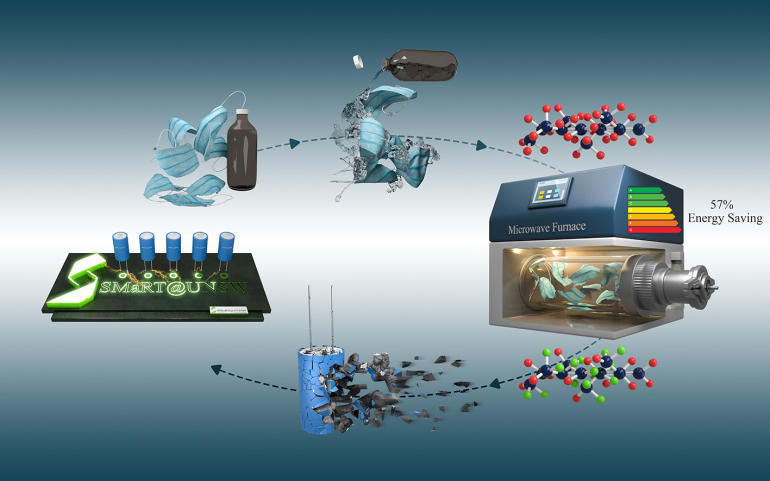
A UNSW SMaRT Centre research study has demonstrated that waste disposable masks can be transformed into a valuable energy-storage material, activated carbon, instead of being sent to landfill or incineration.
Published in Elsevier ScienceDirect's Journal of Energy Storage, the study found the process of conversion was found to be fast, energy efficient, relatively low cost, and capable of producing high-performance supercapacitor electrodes.
This is a strong example of a circular economy approach, where a problematic waste stream becomes a useful resource for clean-energy technologies.
The researchers successfully converted disposable surgical masks into high-performance activated carbon for supercapacitors using an energy-efficient microwave process, achieving excellent storage performance and long-term stability while reducing waste.
The researchers wanted to solve two problems at once:
Their idea was to convert used 3‑ply surgical masks into high-quality activated carbon, which can be used as an electrode material in supercapacitors.
The team developed a microwave-assisted sulfo-carbo-activation process that rapidly transforms polypropylene mask material into activated carbon.
The process:
The treatment also introduces oxygen and sulphur-containing functional groups into the carbon structure, improving its suitability for electrochemical energy storage.
The use of microwave processing significantly improves energy efficiency and scalability, making the approach suitable for rapid deployment during waste surges.
By demonstrating strong electrochemical performance, the work establishes waste-derived plastics as viable precursors for next-generation energy storage materials, reinforcing circular economy principles in waste management.
