
Latest news
Read the latest news from the Centre for Sustainable Materials Research and Technology



UNSW SMaRT Centre's Plastics MICROfactorieTM Technology and commercial partnership with operator Renew IT is getting noticed, and is now becoming part of the Amazon procurement and sustainability system.
As featured in this article published by The Business Profile Magazine, the technology that reforms difficult to recycle hard plastics from electronic waste into filament for 3D printing, is being added to the global company's sustainability network.
Excerpt:
Procurement and sustainability should no longer be scrabbling for a seat at the same table as each other, or indeed the same table as commercial. The former two, more and more, are speaking in a language that the latter can immediately understand, contributing to a future business model where a seamless supply chain and strong ESG are part of the business plan, rather than potential value-adds. This is certainly the case at Amazon and through its TSI division, as explained by Catalin Cazacu and Cath Robinson.
Renew IT are based in Sydney, and they focus on turning IT e-waste plastic into 3D printing filament. What attracted me immediately is they’re solving a problem that sits at the very end of the lifecycle – what do you do with the plastic that can’t be refurbished or reused?
Less than nine percent of all plastic ever produced has been recycled. Most of it ends up in landfill or the environment. IT peripherals are no exception. They typically get shredded and downcycled into low-grade material. Renew IT take that same waste stream and turn it into something that has genuine second-life value.
We’re now exploring how we can feed our peripheral waste – the headset plastics, cable sheathing, the stuff that currently goes to destruction – into their process. It’s still a relatively early-stage partnership, but imagine the end state. The headset you discarded in the office ends up as filament, which gets printed into something useful. That’s genuine circularity.
And, to complete the ecosystem. James, could you please also provide your opinion on your collaboration with Amazon and what’s made it so groundbreaking from a Renew IT perspective?
The ITAD industry itself is very transactional and when I started Renew IT back in 2008, no one was really innovating and listening to the customers challenges, other than collecting their old IT equipment, sanitising the data and reselling it again. I set out on a mission to find answers and that’s when my partnership with the University of New South Wales began. Through meeting Scientia Professor, Veena Sahajwalla AO I saw the microfactories™ she was designing. A microfactory is a modular solution designed to tackle the raw materials in e-waste. We began to work on plastics. Out of 60 million tonnes of e-waste that is disposed of each year, 30 percent of this is ABS plastic. We found that this plastic, through some clever manipulation, made great 3D printer filament. So, we commercialised a filament line that repurposes 4.5 tonnes of ABS plastic each month from 15 tonnes of e-waste.
When we showed this tech to Amazon I could see the eyes light up as this was finally a tangible solution that was being presented, not some PowerPoint presentation with numbers. We ran some pilot studies taking in Amazon-used peripherals, and began converting old keyboards, mice and docking stations into actual products for Amazon such as wastepaper bins.
From the pilot we have now moved to scaling up globally. By anchoring ourselves to Amazon it has allowed us to scale. We have been able to offer our innovation to other customers around the world and begin our journey of making a real difference and keeping e-waste out of landfill."
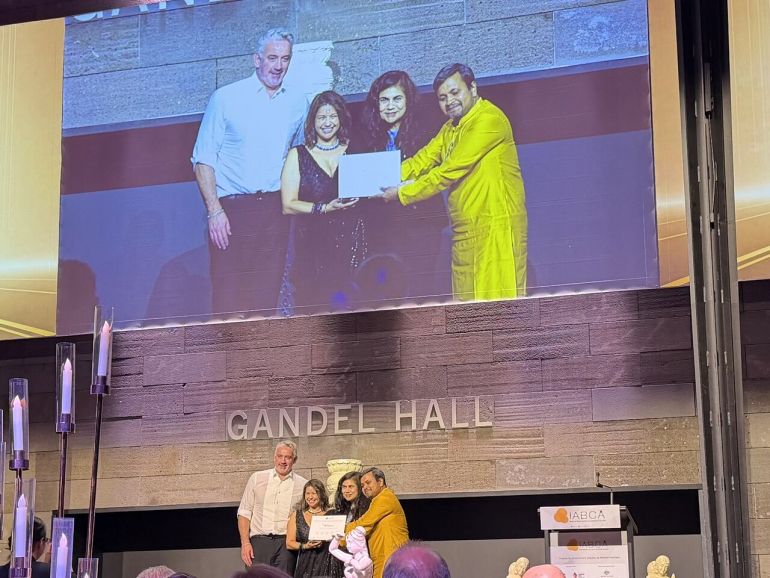
This follows the plastics technology collaboration between SMaRT and Renew IT being recognised with the IABCA Australia India Science, Research & Development Award.
The India Australia Business & Community Alliance (IABCA) hosts the awards annually as part of its remit in convening leaders, innovators, policymakers, investors, and changemakers shaping the Australia-India relationship.
The award recognises the the creation of a novel method of recycling plastic from e-waste into filament for 3D printers, which the SMaRT Centre has pioneered as part of its range of MICROfactorieTM Technologies that reform hard to recycle wastes into products and feedstock for remanufacturing.
The IABCA said: "Congratulations to Renew IT & UNSW SMaRT Centre, the 2026 IABCA Australia India Science, Research & Development Award Winner.
"The collaboration is advancing circular economy innovation by transforming electronic waste into valuable materials and manufacturing inputs.
"Through next-generation processing and micro-manufacturing technology, valuable materials can be recovered from e-waste, while recovered plastics can be repurposed for applications including 3D-printing filament.
"The partnership demonstrates the potential of Australia–India collaboration in sustainable technology, advanced manufacturing, research and circular economy solutions."
Based in Sydney, Renew IT is an IT asset management specialist that also provides managed IT services and e-waste recycling.
In partnership with the UNSW SMaRT Centre, the company funded the research and development of the MicrofactorieTM, a small-footprint facility that converts acrylonitrile butadiene styrene (ABS) plastics into high-value 3D printer filament and injection moulding feedstock.
The initiative was first piloted in 2023 after 18 months of research and development with the UNSW SMaRT Centre, led by sustainable materials expert Professor Veena Sahajwalla.
Production was expanded in 2024 to operate 7 days a week, producing over 200 spools of filament a day.
Renew IT says that the MicrofactorieTM diverts 4.2 tonnes of plastic waste from landfill each month, estimating that this also prevented over 34 tonnes of CO₂ emissions, based on lifecycle assessments of virgin plastic production versus recycled output.
It produces 210 spools of filament a day, which are quality-tested and independently verified to meet industry-standards, which it sells at a profit, making it a more sustainable endeavour and demonstrating how environmental and commercial goals can align.
The Microfactories are overseen with robust ESG frameworks that include traceability of recovered materials, reporting on environmental outcomes, and compliance with ISO standards ISO 14001 (Environmental Management) and ISO 45001 (Occupational Health & Safety), as well as recycling certifications.
All recovered plastics are traced from collection through processing and sale, with independent audits and lifecycle assessments conducted by university researchers and sustainability consultants.
Reports on these ESG metrics also allow corporate clients to support their sustainability disclosures and Scope 3 emissions tracking.
The company said it has had interest from schools, universities, manufacturers, and government agencies seeking low-carbon, locally made alternatives to virgin plastic.
Details of the March 2025 official opening:
UNSW Vice Chancellor and President, Professor Attila Brungs officially opens a UNSW Sydney-designed Plastics Filament MICROfactorieTM in Sydney.
Electronic waste recycler Renew IT has added the MICROfactorieTM module to its national headquartered facility in Lane Cove to reform the hard plastics normally discarded from e-waste into valuable filament for 3D manufacturing and printing.
Developed by and licensed to the UNSW Centre for Sustainable Materials Research and Technology (SMaRT) Centre, the Plastics MICROfactorieTM module is the first commercial operation and use of the technology outside of the UNSW SMaRT Centre.
See the Waste Management Review news story
Professor Brungs said: “After an extensive testing and commissioning phase, I am pleased to open Renew IT’s Plastics MICROfactorieTM module,” he said.
“I’m excited by the positive impact that’s come as a result of UNSW’s research, innovation and collaborative partnerships. This facility has already demonstrated significant economic, social and environmental benefits, so far keeping 50.4 tonnes of plastic waste out of landfill and incinerators. New jobs and revenue have also been created, and the technology is creating a circular economy where materials are used over and over again, maximising the value of our resources.”
Renew IT CEO James Lancaster said the technology is a game changer for his organisation, enabling a more efficient method of using all of the resources found in complex e-waste items.
“Electronic goods are a growing waste problem and even though there have been some recent bans on allowing e-waste to go to landfill, that is where is often ends up. For us, the hard ABS plastics found in so many e-waste items don’t have a market, so this technology is game changer in addressing that problem.”
“If 3D printing feedstock can be competitively produced by recycling hard plastics, we shouldn’t be producing it with virgin materials and then importing it from overseas, where almost most of the filament in Australia comes from,” he said.
The Plastics MICROfactorieTM module is the latest of a number of MICROfactorieTM Technologies undergoing commercialisation by the UNSW SMaRT Centre, with a Green Ceramics MICROfactorieTM module operating in Nowra in regional NSW and a Green Aluminium MICROfactorieTM module under construction in Taree, NSW.
UNSW SMaRT Centre Founder and Director, Professor Veena Sahajwalla said: “Recovering materials from waste has a big role to play as we move towards a sustainable future and reducing our carbon footprint.
“Many of the materials needed for our future needs are finite in supply, so using innovative technologies to reform waste into value-added feedstock for remanufacturing means we can also accelerate our sovereign manufacturing capability. Waste itself can, and must, be seen as a resource with economic and social benefits as we strive to be more sustainable.”
Filament, while almost entirely imported to Australia, is made from petrochemicals, thus being able to locally make it from used plastics also reduces the environmental impacts from global freight. Veena said 3D printing is becoming widespread across society, from schools to manufacturing facilities able to create new parts and products locally which also reduces importation.
“ABS hard plastics are sometimes recycled as pellets for remanufacturing but this is very low value and energy intensive, selling at around $2 per kilo (Source: Alibaba March 2025), so not a lot of it occurs compared to the amount of this plastic available. Whereas filament sells for a lot more and so this solution is a high value solution delivering real circular economy benefits.
“I believe Plastics Filament MICROfactoriesTM have the potential to revolutionise 3D printer filament creation and I look forward to a time when 3D printing feedstock is sourced exclusively from recycled hard plastics,” she said.
Background:
Australia generates about 500,000 tonnes of e-waste annually, according to the latest available data from the federal government's Department of Climate Change, Energy, the Environment and Water.
That means each Australian produces about 20kg of e-waste a year, compared with the global average of 7kg. Onshore, Australia generated a total of 511,000 tonnes of e-waste with a recycle rate of 12%.
The amount of waste is projected to rise nearly 30 per cent by 2030 to 657,000 tonnes. It's supposed to be disposed of at special drop-off points, but it often ends up in kerbside rubbish collection, resulting in fires and costly clean-up bills.
Globally, there was approximately 62 million tonnes of e-waste generated with less than 22% being recycled, according to the Global E-waste Monitor 2024 Report.
Video of the Lane Cove Plastics MICROfactorieTM at https://youtu.be/fd0LDoG6ygQ.
Media contacts:

Renew IT Founder and CEO James Lancaster and UNSW SMaRT Centre Founder and Director, Professor Veena Sahajwalla.