Latest news
Read the latest news from the Centre for Sustainable Materials Research and Technology


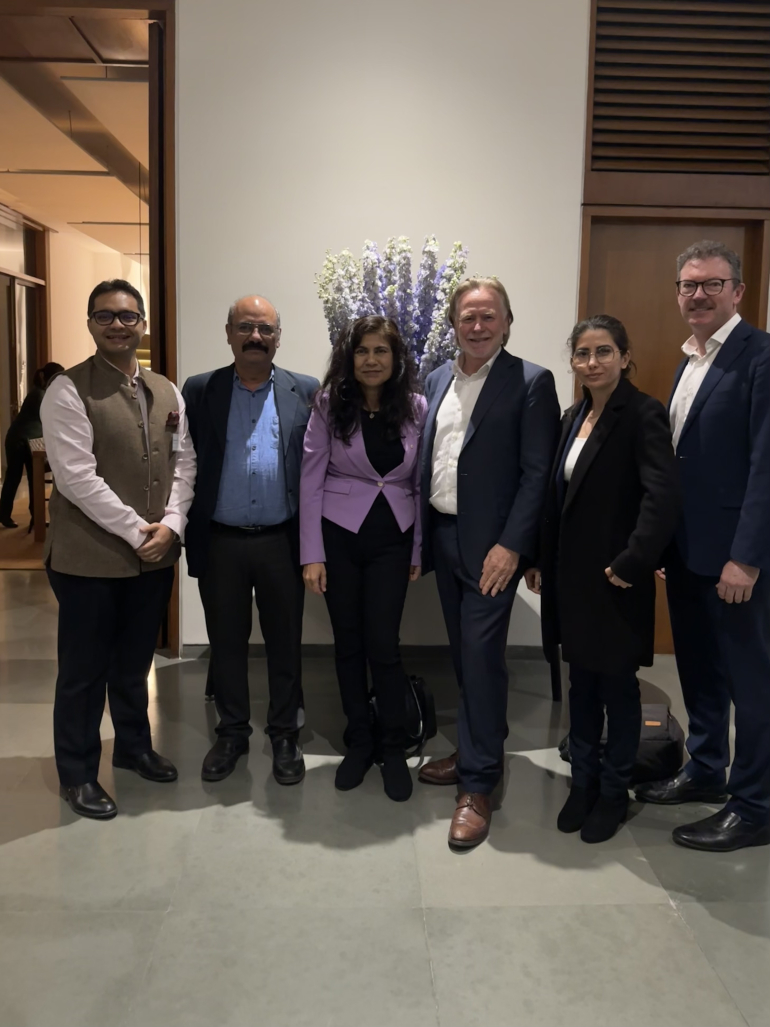
Image: team UNSW SMaRT Centre with Indian industry partner JSW Steel and Australian High Commissioner to India, Philip Green OAM.
UNSW SMaRT Centre has been participating in a series of meetings and events in India as part of bilateral initiatives between Australia and India.
In the latest visit to India currently underway, UNSW SMaRT Centre Director Prof Veena and other personnel are progressing relationships and partnerships with India entities, to both inspire and collaborate on research and development, with SMaRT's various waste and recycling technologies generating a lot of interest.
A visit to India steel giant JSW Steel took place following a recent announcement of a partnership between JSW Steel and SMaRT Centre on the sidelines for the signing of the bilateral Indian-Australia decarbonisation initiative under the Australian Government's Renewable Energy Partnership Tech Challenge.

They attend an event at the Office of the Australian Consul General in Mumbia (Paul Murphy) in honour of the Australian Institute of Architects, and also at the the Australian High Commission, New Delhi, with Commissioner Philip Green OAM, to strengthen a new partnership SMaRT has in India as part of the Australia Government's new Technology Commercialisation Challenge hosted by the CSIRO.
The CSIRO said: "Our Technology Commercialisation Challenge (TCC) Cohort are bringing together Indian industry and Australian researchers to develop and commercialise new renewable technologies.
"As part of this work, the TCC team recently attended a special event, hosted by the Australian High Commission, New Delhi.
"Bringing together government, industry, and researchers from Australia and India, the event helped energise and strengthen our cross-country partnership."
"The TCC, part of the India-Australia Renewable Energy Partnership, is proudly funded by the Department of Climate Change, Energy, the Environment and Water."

Image: NSW Trade and Investment Commissioner for India, Malini Dutt, with Veena at the Mumbai event.
Investment NSW has also been facilitating collaborations, and NSW Trade and Investment Commissioner for India, Malini Dutt said: "In two weeks Investment NSW will host the smart cities and urban transportation mission to India.
"Nine NSW, Australia based technology providers offering technologies for rail, infrastructure ports and built environment will present their smart solutions and explore possibilities to meet India's burgeoning demand.
"It was thus my pleasure to attend a fantastic evening hosted by our lovely Australian Consul General Paul Murphy in honour of the Australian Institute of Architects. Highlight of the evening was to hear from the very impressive Nawin Sona Natesan on plans of urban development of the maximum city Mumbai and the state of Maharashtra.
"NSW shares a sister state relationship with Maharashtra state and there is a lot of bilateral exchange possible in urban development, energy technology, next gen technology and many other areas. I discovered this as our science and technology expert Veena Sahajwalla AO generated tremendous curiosity around SMaRT's various MicrofactorieTM Technologies."
Veena and team also attended the India–Australia Business Summit 2025, hosted by the Indo-Australian Chamber of Commerce on 4th December at the Radisson Blu Plaza, New Delhi.
The summit was a landmark platform that brought together the sharpest minds, industry leaders, innovators, policy-makers, diplomats, and visionaries committed to shaping the next era of India–Australia collaboration. From strategic dialogues to sector-focused deep dives, the Summit showcased the depth, scale, and ambition of the bilateral partnership.
Background on JSW and SMaRT partnership:
JSW and SMaRT are collaborating on a technology and research based on SMaRT's Green SteelTM Polymer Injection Technology, which reforms waste rubber tyres and other waste polymers as alternative to coke and coal in electric arc steel making.
Investment NSW's Trade and Investment Commissioner for India, Malini Dutt said at the time: "Investment NSW had the pleasure of bringing together JSW Steel and UNSW SMaRT Center in presence of the Australian Energy Minister Bowen who witnessed the signing of a decarbonisation partnership under the Australian Government's Renewable Energy Partnership Tech Challenge.
"The project involves developing in-situ H₂ from end-of-life rubber tires to cut emissions in green steel - first amongst the six partnerships launched.
"This perfectly aligns with the recently launched NSW Government's trade and investment strategy with energy transition having been identified as a key pillar."
SMaRT's Green SteelTM Polymer Injection Technology not only liberates from waste the essential carbon elements needed for steel making, but hydrogen which together enable a more efficient process that enhances yield and reduces emissions.
Administered by the CSIRO, the approved JSW/SMaRT partnership under the Government's Renewable Energy Partnership Tech Challenge says the the project will "develop in-situ hydrogen generation from waste polymers to enable reduced carbon emissions in the manufacture of green steel".
Minister Bowen said: “Both Australia and India understand the need to work together on tackling the climate challenge and are ready to seize the energy transformation opportunity before us.”
The Tech Challenge Green Steel partnership announcement comes after the UNSW SMaRT Centre and the Steel Research and Technology Mission of India (SRTMI) entered into a partnership to collaborate on green steel manufacturing, decarbonisation, recycling, and advanced steel technologies.
The Memorandum of Understanding was signed during the India Steel Expo 2025, with support from Investment NSW, and builds on the Australia India Green Steel initiative under the Australia India Economic Cooperation and Trade Agreement and highlights how UNSW Sydney is supporting homegrown research to deliver global and economic impact.
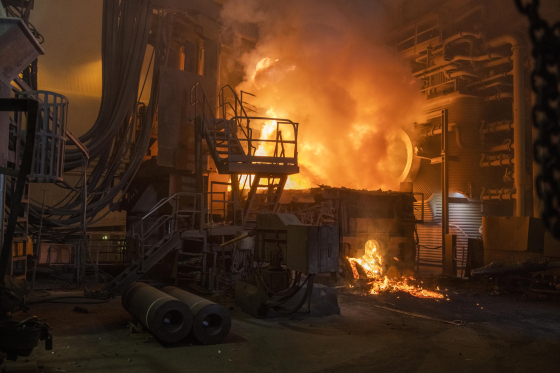
Professor Veena Sahajwalla said it is crucial for manufacturers and researchers to work to tackle environmental issues, while delivering commercial outcomes.
“Climate change and clean energy narratives often overlook the need for more sustainable manufacturing and waste management practices, where we start to use waste resources for future manufacturing needs.
"Natural resources alone will not deliver the feedstock supply for all of society’s needs, so we need a far more sustainable approach, like some of the innovative recycling technologies we’ve developed at the UNSW SMaRT Centre.”
“By working collaboratively with partners we have been able to prove that polymer injection works and is commercially viable. It is only through partnerships that we can truly achieve positive environmental outcomes at scale.
“I encourage all manufacturers to engage with your local research institution and challenge them with a business issue that needs solving. Conversely, I recommend researchers go out into the field and work with industry because there are really interesting, practical challenges to solve.”
The global steel industry faces significant challenges, as current production methods rely heavily on coal, resulting in high carbon emissions.
With steel demand projected to rise by 30% by 2050, the industry must balance growth with the urgent need to reduce its environmental impact and meet climate neutrality targets set by the Paris Climate Accord.
A later UNSW announcement stated:
The MoU lays the groundwork for a two-year collaboration aimed at delivering impactful research outcomes and strengthening academic and industry ties between Australia and India. The agreement was formalised during the India Steel 2025 international conference at the Bombay Exhibition Centre in Mumbai.
The signing ceremony was witnessed by His Excellency Mr Philip Green, High Commissioner of Australia to India, and Shri Amarendu Prakash, Chairman of the Steel Authority of India Limited and President of SRTMI, alongside senior officials and researchers from both the steel and academic sectors.
Under the agreement, UNSW academics will work closely with India’s steel producers and industry experts to develop innovative solutions that improve the efficiency and sustainability of steel production and use.
Key areas of collaboration include:
Science-led innovation tackling environmental challenges
Professor Veena Sahajwalla, founding Director of the UNSW SMaRT Centre and a global leader in sustainable materials research, said the collaboration highlights the University’s world-leading expertise in tackling major environmental challenges.
“Steel is a critical commodity for national development, but we must make its production more efficient and environmentally responsible. This MoU with SRTMI reflects our shared commitment to advancing a circular economy by transforming complex waste into valuable inputs for sustainable steelmaking,” she said.
“I’m proud that the Green SteelTM Polymer Injection Technology, developed at UNSW, is reimagining waste as a resource and driving innovations for sustainable industrial growth. It’s a powerful example of science-led innovation making a real-world impact, and I look forward to sharing this technology through this partnership.”
As part of the agreement, UNSW and SRTMI will collaborate on joint research projects, academic and scientific exchanges, and training programs aimed at building industry capability. These efforts support global sustainability goals and the transition to a low-carbon future.

Mr Green, Australia’s High Commissioner to India, welcomed the agreement.
“I commend UNSW, SRTMI, and the Ministry of Steel for this initiative,” he said.
“This MoU builds on the existing India-Australia Green Steel Partnership to tackle some of the most pressing technological challenges in the steel sector, including decarbonisation, circular economy, and digital transformation.
“The steel industry is fundamental to economic development and national security. Australia and India bring complementary strengths: we are the world’s largest exporter of iron ore, and India is the second-largest producer and consumer of steel. Given that steel and iron production accounts for around 9% of global greenhouse gas emissions, the sector is at the forefront of the global energy transition.”
Shri Amarendu Prakash, Chairman of the Steel Authority of India Limited and President of SRTMI, said the partnership marked a pivotal moment for Indian steel research and development.
“It aligns with our national vision of developing indigenous, sustainable, and globally competitive technologies,” he said.
“This MoU will act as a catalyst for high-impact research and international collaboration in areas such as decarbonisation, advanced materials, and digital innovation.”
Established by the Ministry of Steel, Government of India, in collaboration with key stakeholders from the Indian steel sector, SRTMI’s mission is to enhance the industry’s global competitiveness through focused research, innovation, and strategic partnerships.
Neha Verma, Director of SRTMI, said she was optimistic about the potential of the collaboration.
“The MoU with UNSW Sydney opens new avenues for developing transformative solutions tailored to India’s unique challenges,” she said.
“Together, we aim to deliver technological breakthroughs that can redefine sustainable steel production in India and beyond.”
Green SteelTM PIT aligns perfectly with the broader goals of a hydrogen-based decarbonisation strategy. By offering an efficient and technically viable method for reducing carbon emissions in steel production, it eliminates the immediate need for large-scale hydrogen storage and transportation, addressing key barriers to hydrogen adoption.
Green SteelTM PIT uses rubber tyres and other sources rich source in carbon and hydrogen, in EAC furnaces, and balances different chemical reactions to liberating hydrogen enabling a more efficient steel production.
Furthermore, Green SteelTM PIT supports resource efficiency and promotes a circular economy by utilising waste materials as valuable feedstock.