
Latest news
Read the latest news from the Centre for Sustainable Materials Research and Technology


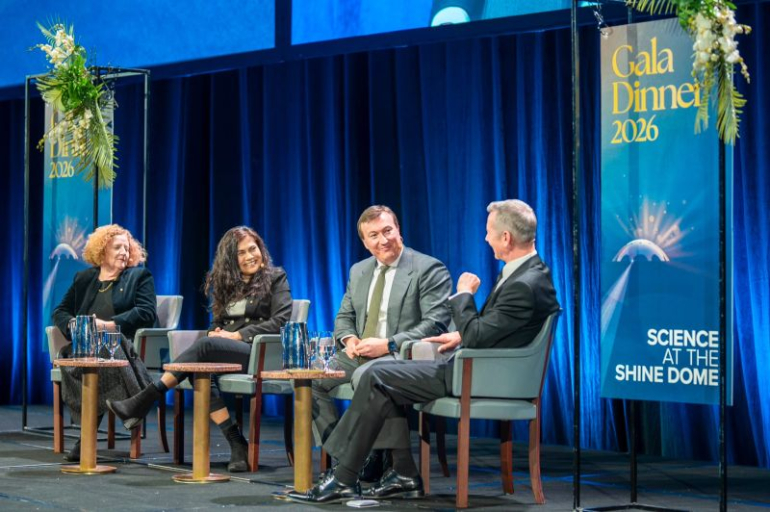
UNSW SMaRT Centre Director, Prof Veena Sahajwalla spoke at the recent Science at the Shine Dome 2026 event in Canberra, the Australian Academy of Science’s flagship annual event.
The Academy says: "Together, we will honour outstanding achievements and celebrate excellence spanning the breadth and depth of Australian science. Fellows elected in 2026 will sign the historic Charter Book, joining the ranks of the country’s scientific greats. Recipients of the Academy’s prestigious awards will showcase their discoveries and innovation.
"Delegates gain unique insights from the nation’s brightest minds and be part of cutting-edge conversations. For early- and mid-career researchers, this is an unparalleled opportunity to network and forge new collaborations."
As an academcy Fellow, Veena spoke about her path to success and career researching and developing recycling innovations such as UNSW SMaRT Centre's MICROfactorieTM Technologies and its Green SteelTM Polymer Injection Technology that recover valuable materials from waste and reform them into new manufacturing feedstock and products are central to help achieve materials sustainability and for the energy system needed for the future.
"We discussed how strengthening Australia’s R&D capability can drive innovation and support the development of technologies such as our very own that recover valuable materials from waste and reform them into new manufacturing feedstock and products to help achieve materials sustainability and support the energy system transition needed for the future," she said.
Veena also highlighted SMaRT's work on researching solutions for battery recycling and metals resource recovery using innovative and collaborative opportunities to help create circular economies while enhancing sovereign capability while reducing reliance on global supply chains.
At the Parliament House event, the session involved: Moderator: Peter Hartcher, political editor and international editor, The Sydney Morning Herald In conversation with: Bran Black, Chief Executive, Business Council of Australia Professor Veena Sahajwalla AO FAA FTSE, UNSW Sydney Professor Margaret Sheil AO FAA FTSE, Australian Academy of Science.
Excerpt from the Academy news story:
The panel, moderated by journalist Peter Hartcher, also included Professor Margaret Sheil, the Academy’s Secretary Science Policy, and Professor Veena Sahajwalla, Academy Fellow.
The discussion opened by sketching a vision for a restored R&D sector, 20 years from now: sovereign capability built from fundamental discovery through to local manufacturing, and opportunities reaching every community, regional and urban alike.
But Australia’s current investment in R&D sits well below the OECD average, as the Academy’s recent Restore Science campaign has brought to national attention.
The panel agreed that this shortfall carries a real social and economic cost.
Black noted that a substantial proportion of Australia’s backslide in R&D investment compared to peers could be chalked up to lagging business R&D investment, which is a full percentage point behind the OECD average.
“What we need to be doing in order to facilitate more [business] investment is making sure that we’ve got more competitive settings across the board,” he said, pointing to the R&D tax incentive and company tax rate as potential levers and prompting a lively discussion about the settings in other innovation-driven nations, such as Germany.
Professor Sahajwalla highlighted the importance closer, faster collaboration between researchers, industry and communities, with people at the centre. “If we want to be able to retain talented people in Australia and bring more talent into the country, we have to ask the question: are we creating an ecosystem that allows people to move seamlessly between research and business?” she said.
Professor Sheil noted that translation doesn’t just happen. It needs stable, long-term funding. “We won’t be able to translate anything if we don’t have fundamental discoveries to translate,” she said, pointing to quantum technology as being built “on the back of investments through the ARC and other funding agencies 20 years ago”.
“Counterintuitively, you get more innovation with longer term funding … when there's more certainty, people take more risks,” she added.
Professor Sheil recalled the energy and excitement generated by the ‘Backing Australia’s ability’ innovation action plan from 2001, which brought together business and research.
“We attracted great people to this country. We attracted great students into science. And so I think we need some enthusiasm and hope, and to spend a little less time worrying about the mechanics,” she said.