
Latest news
Read the latest news from the Centre for Sustainable Materials Research and Technology



A research study by UNSW SMaRT Centre researchers provides little known insights into the causes of microplastics from plastic waste.
The study concludes that photodegradation is a key driver in the formation of secondary microplastics from packaging waste, and demonstrates that sunlight progressively alters the chemistry and structure of common packaging plastics until they become brittle and begin to fragment.
The work provides a clearer understanding of when this transition occurs for different polymer types and highlights that material choice and package thickness can have a major influence on the rate at which microplastics are generated.
The authors argue that this knowledge can help improve packaging design, support better waste-management strategies, and ultimately reduce the environmental burden of microplastic pollution.
The paper, published by Elsevier ScienceDirect's Journal of Hazardous Materials Advances, set out to answer a fundamental question in the microplastics field: at what point does common plastic packaging begin its transition from an intact product into microplastics when exposed to sunlight?
The authors focused on three of the most widely used packaging plastics, polyethylene terephthalate (PET), polypropylene (PP), and high-density polyethylene (HDPE), and exposed them to simulated sunlight for up to 1,000 hours.
Their goal was not simply to show that plastics degrade, which is already well known, but to identify the critical stage at which degradation becomes severe enough to initiate the formation of microplastics.
To do this, the researchers monitored a wide range of chemical, physical, optical, and mechanical changes as the plastics aged. They used advanced analytical techniques to examine how the material surfaces changed, how their chemistry evolved, how their colour shifted, and how their mechanical strength deteriorated over time.
By combining all of these measurements, the study was able to create a detailed picture of the pathway through which large plastic items gradually fragment into much smaller particles.
The study found that the three plastics did not degrade at the same rate.
PET was the most vulnerable to sunlight-induced degradation, showing substantial surface damage after only about 100 hours of exposure.
Polypropylene degraded more slowly, with significant changes becoming apparent after approximately 750 hours, while HDPE proved to be the most resistant, requiring around 1,000 hours before comparable degradation features emerged.
These differences reflect the underlying chemistry of the polymers and explain why some packaging materials may become sources of microplastics more quickly than others when exposed to environmental conditions.
As exposure increased, all three plastics experienced progressive chemical oxidation and physical deterioration. Their surfaces became rougher and more damaged, and their mechanical properties weakened.
The researchers found that these changes were accompanied by measurable weight loss, which they interpreted as evidence of ongoing fragmentation and microplastic generation. Importantly, this weight loss followed a predictable linear pattern for all three polymers, suggesting that degradation progresses systematically rather than randomly once it has begun.
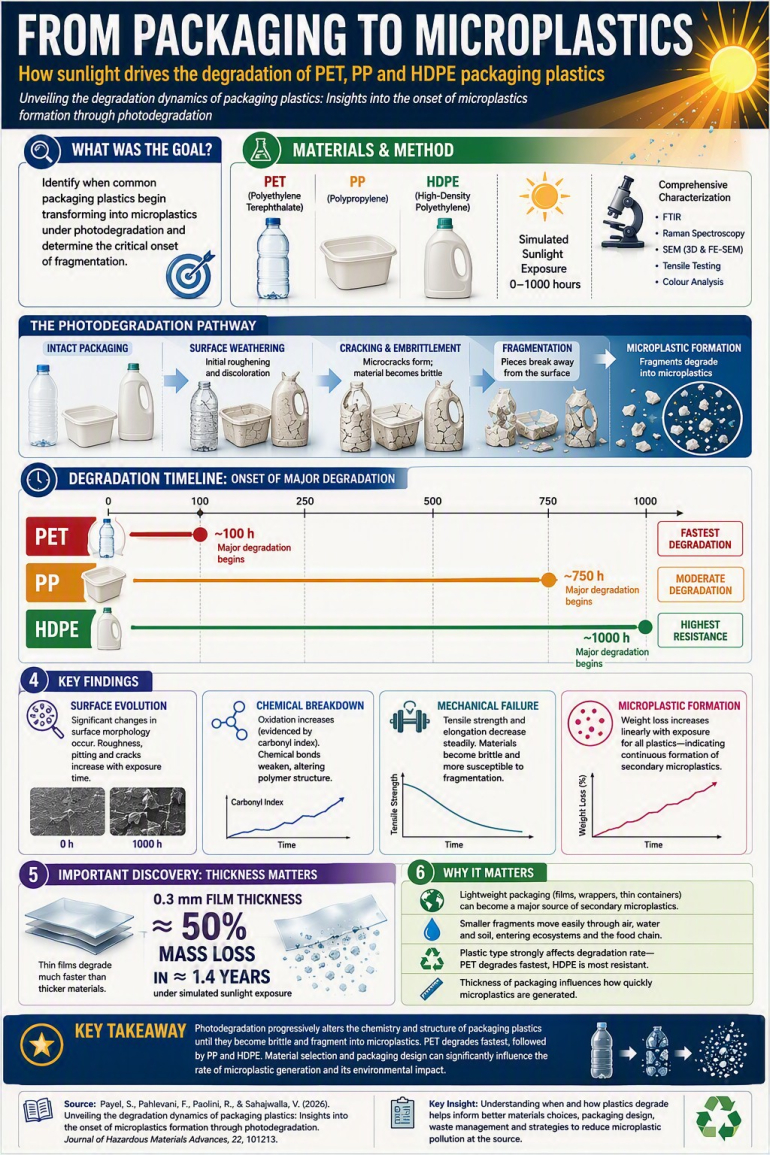
One of the most significant findings was that the rate of degradation depended strongly on the thickness of the plastic.
Thin plastic films degraded much faster than thicker materials. Based on their results, the authors estimated that a plastic film only 0.3 mm thick could lose half of its mass in about 1.4 years under the tested conditions.
This indicates that lightweight packaging materials, films, and wrappers may be particularly important contributors to environmental microplastic pollution because they can break down comparatively quickly once exposed to sunlight.
This study was done as part of the Sustainable Communities and Waste Hub, headed by SMaRT and Prof Veena, with funding from the Australian Government under the National Environmental Science Program.