
Latest news
Read the latest news from the Centre for Sustainable Materials Research and Technology



In an article published by Nature, UNSW SMaRT Centre researchers and international colleagues demonstrate that repurposing waste streams for a new generation of sensors is not only possible but should be prioritorised.
This report builds on years of pioneering research into the "science of microrecycling" and the development of technologies and processes that reform and recover valuable materials from waste for new uses: as feedstock for remanufacturing and new products.
This circular economy approach for materials through advanced recycling and manufacturing is part of the wider body of work creating innovations such as UNSW SMaRT Centre's MICROfactorieTM Technologies and its Green SteelTM Polymer Injection Technology that recover valuable materials from waste and reform them into new manufacturing feedstock and products are central to help achieve the sustainable energy system needed for the future.
By Tamer Shoeib, Rumana Hossain, Ruslan Álvarez, Hazhir Teymourian, Veena Sahajwalla,
Arben Merkoçi & Joseph Wang
Industrial and electronic wastes represent a dual crisis of resource loss and environmental harm. Such urban ore can be repurposed by upcycling flash-converted waste carbon into recovered metal oxides. This process yields high-performance nanomaterials for fabrication into intelligent, sustainable sensors, while mitigating waste in a convergence of circular economies.
The dual imperative: waste and sensing
The twenty-first century is defined by two parallel material challenges: the disposal of monumental waste streams and escalating demand for intelligent sensing. Industrial and electronic waste, the fastest growing global waste category, represents both a critical loss of finite resources and a persistent environmental contamination, with genera-tion reaching approximately 62 megatonnes in 2022, nearly double that of a decade ago, and growing five times faster than compliant collection and recycling1. Simultaneously, the data-driven society demands wide-spread, low-cost, sustainable sensors for public health, industrial safety and environmental monitoring. Traditionally, sensor manufacturing has relied on energy-intensive virgin materials.
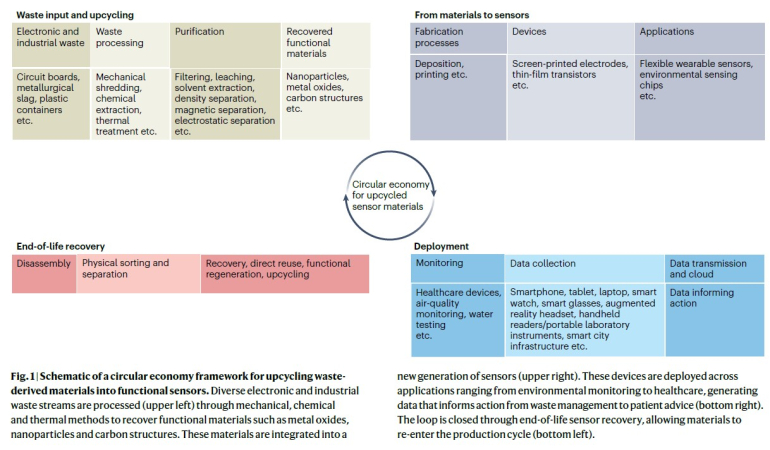
We argue that transformative waste-to-sensor convergence is now possible. Advances in sustainable material science and precision engineering are enabling electronic, industrial and polymeric wastes to serve as strategic feedstock for next-generation sensors (Fig. 1). Here we outline key techniques for recovering waste-derived sensor
materials, showcase breakthroughs across applications, and chart a path from laboratory innovations to global impact.
From waste to functional material
The concept of urban ore reframes electronic and industrial wastes as a strategically engineered resource rather than an end-of-life liability. Modern waste streams contain high concentrations of functional carbon and critical metals — such as Li, Co and Ni from batteries; Cu and Au from circuit boards; and rare-earth elements like Nd and Dy from magnets — making them attractive feedstocks for sensor-relevant carbons and metal oxides.
Unlike geological resources, these materials have already been refined, doped and structured through manufacturing processes, offering a unique opportunity for direct conversion into advanced functional materials4. Targeted harvesting can selectively recover high-value functional fractions: transition-metal oxides, carbon-rich architectures and conductive polymers, whose inherited structural complexity can be directly exploited in sensing.
Recent advances in upcycling methods prioritize low-energy, selective and environmentally compatible processes3. Their environmental advantages must be verified through life-cycle assessments and techno-economic analyses accounting for reagent and energy consumption, recovery yield, wastewater generation and transport logistics.
At scale, upcycling is most compelling when it replaces multi-step, high-temperature refining with selective, high-yield processes using recyclable or low-toxicity reagents employed near the waste source. These approaches can be coupled with sol–gel synthesis, controlled precipitation or thermal conversion to generate nanostructured oxides with tunable crystallinity, defect density and surface chemistry. Complementary thermal strategies, including flash Joule heating and rapid calcination, can transform heterogeneous waste mixtures into phase-pure, defect-engineered materials within seconds, offering unprecedented scalability and compositional control6.
The scientific motivation for using waste-derived materials in sensors extends beyond sustainability. Hybridizing waste-derived carbons with metal oxides leverages complex microstructures from diverse precursors such as biomass, industrial residues and electronic waste. These materials typically exhibit hierarchical porosity, abundant surface functional groups, heteroatom doping, mixed phases and intrinsic defects; features that directly govern adsorption, charge transfer and mass transport. Rather than being a limitation, this het-erogeneity can be functionally exploited to enhance sensitivity, selec-tivity and stability across electrochemical, optical and chemiresistive transduction mechanisms7.
As a result, such composites frequently demonstrate enhanced charge-transfer kinetics, increased electroactive surface area and synergistic redox behaviour. Because many sensing modalities are dominated by interfacial rather than bulk phenomena, the unique microstructure of waste-derived hybrid materials serves as a powerful functional design variable. Representative demonstrations achieving performance comparable to, and at times surpassing, conventional platforms include the detection of As3+ at 0.24 parts per billion8, the simultaneous detection of Cd2+, Pb2+ and Hg2+ with limits of 1.01–1.13 parts per billion9 and sensitive NO2 detection.
Engineering sensors from non-virgin materials for diverse applications
Environmental monitoring provides a particularly suitable applica-tion domain. In electrochemical sensing, biomass-derived carbons and biochar exhibit high surface area, tunable porosity and surfaces, rich in functional groups that facilitate analyte preconcentration and accelerate interfacial electron transfer. These materials have been widely explored for the purpose of detecting trace contaminants, such as heavy-metal ions in water10. Reclaimed electronic waste com-bined with functional oxides enable the simultaneous sensing of several heavy metals at trace levels9, while reclaimed gold and copper from circuit boards form the basis of sensitive sensors for pesticides and pharmaceuticals.
In chemiresistive gas sensors, non-idealities can be functional where mixed oxide phases, defect-rich surfaces and heterojunctions modulate potential barriers and charge-carrier distributions, often enhancing response magnitude and reducing response and recovery times. For example, carbonaceous materials derived from pyrolysed plastic casings can be used in devices for monitoring volatile organic compounds and in defect-engineered mixed oxides used for carbon monoxide sensing11. However, achieving selectivity in complex gas mixtures and cross-sensitivity to humidity and temperature remain challenges, typically requiring complementary strategies such as sensor arrays or multivariate data analysis12. For optical sensing, rare-earth elements recovered from display phosphors and magnets are being integrated into fluorescent sensors for real-time visual alerts.
Beyond environmental monitoring, upcycled electronic waste is employed in wearable biosensors that electrochemically monitor metabolites like lactate and glucose in sweat. Wearable sensing imposes unique constraints beyond analytical performance, requiring mechani-cal resiliency, fatigue resistance and stable function under hydration and ionic strength of skin. Carbonized textiles and polymer wastes are particularly promising, because thermal conversion can preserve their original fibrous and porous morphologies, creating mechanically robust, percolating networks that facilitate analyte transport while maintaining electrical connectivity under deformation.
Recent circular-by-design wearable electronics demonstrate credible end-of-life pathways. A closed-loop strategy has been demonstrated in which wearable electronic textiles are converted into graphene-like recycled powders and re-coated onto textiles to produce electrocardiogram electrodes and temperature sensors13. Complementary recyclable architectures using printable metal nanowire conductors on recyclable gel substrates maintain stable electrode–skin impedance under strain. Another high-impact oppor-tunity is formulating electronic-waste-derived conductive inks into printable electrodes for point-of-care assays. The key engineering objective becomes matrix-tolerant interfaces, combining antifouling coatings with stable redox mediation, rather than perfect upstream feedstock uniformity.
Taking a fundamentally different approach that prioritizes full elimination over recovery, transient wearable sensors embody a direct sensor-to-waste paradigm. Engineered to completely disintegrate into environmentally benign byproducts after their operational lifespan, these self-degradable devices circumvent collection and reprocessing. However, the identity, concentration and release kinetics of byproducts must be carefully controlled to prevent unintended environmental impacts such as soil or water degradation and microbicidal accumula-tion. This strategy offers an ultimate form of waste prevention when degradation products are properly managed.
Energy autonomy is another area in which circular materials matter. Biomass-derived hydrogels and carbon networks from agro-industrial waste have been engineered into stretchable, self-healing, energy-harvesting systems that simultaneously function as tactile or pressure sensors. Industrial sensing demands sustained operation under chemically aggressive, thermally fluctuating conditions14. Waste-derived carbon–metal-oxide hybrids offer robustness, tunability and economic viability15. One of the clearest industrial precedents is the use of recovered precious metals (platinum and palladium from spent auto-motive catalytic converters and electronic waste) in commercial gas and electrochemical sensors, demonstrating that secondary resources can meet stringent reliability requirements.
In agri-food applications, porous carbons derived from industrial waste and laser-induced graphene architectures fabricated directly on agricultural byproducts have been investigated for use in detecting agrochemicals and soil-relevant parameters. Using this approach, orange peel has been shown to be effective for detecting organo-phosphate pesticides, demonstrating how agro-industrial waste can serve as both carbon source and device substrate for rapid, low-cost, field-deployable sensing16. Waste-derived luminescent nanomaterials, such as carbon dots, are being explored for use in optical sensing and intelligent packaging.
The impact of waste-derived sensing materials depends on integration into scalable device architectures. Printing and additive manufacturing bridge the gap between heterogeneous feedstocks and deployable sensors by enabling controlled patterning on flexible substrates and reducing fabrication waste. Because circular feedstocks vary, an effective strategy may be to shift from material uniformity to system tolerance. Promising approaches that can stabilize device-level performance include composite formulations that buffer variability, electrode geometries that spatially average the response, and cali-bration approaches that decouple analytical accuracy from absolute material uniformity. Thus, circular sensors should be engineered as calibration-tolerant systems where variability is bound by architecture, algorithms and quality-assurance metrics. To close the loop, circular electrode platforms should consistently report print and run-to-run variability metrics, matrix-aware validation and calibration strategies designed around sensor-to-sensor variation and drift.
The path to impact: systems thinking and circular design
The ultimate promise of waste-derived sensors transcends individual device performance. A systems-thinking approach must be adopted that considers the entire sensor lifecycle, from feedstock to end-of-use, and that embeds circular design as a fundamental engineering constraint. This paradigm shifts the field from material substitution towards creating a regenerative, intelligent technological ecosystem.
The intuitive appeal of using waste must, however, be validated by rigorous analysis, guided by a central criterion: a sensor fabricated from reclaimed materials must provide a net-positive advantage over its virgin counterpart under clearly defined conditions. This requires a comprehensive life-cycle analysis to account for the energy and chemical inputs of upcycling, scalability, yield, operational stability and device lifetime, where design for disassembly, recycling or benign degradation is paramount. In parallel, techno-economic analysis must demonstrate the viability of scaling green processes, where the business case is built not on cost parity alone but on added value from regulatory compliance, resource resilience and sustainable branding. True innovation lies in embedding the sensor within a closed-loop, locally adaptive system. We envision a circular sensing ecosystem where post-consumer and industrial waste is processed through distributed upcycling hubs into tailored functional materials, then fabricated into sensors for local monitoring needs (from diagnostic devices to environmental applications), enabling sensors to transition from passive endpoints to the critical data-gathering nexus. Trans-mitted wirelessly, this data can inform decisions on public health, or environmental management, creating a feedback loop that closes the material cycle (Fig. 1). This model is particularly transformative for communities in the Global South, converting waste liabilities into tools for environmental sovereignty.
Technological readiness requires an enabling framework. Standardized protocols for certifying waste-derived sensing materials are essential for reliability and market trust. Such certification must incorporate batch-resolved compositional fingerprinting and statistical validation across independent material lots, with defined inter-batch variability thresholds to ensure reproducible device performance. Green procurement policies should create the necessary demand. This vision necessitates a new principle for sensor engineering, in which optimal performance is redefined within circular material flows, championing feedstock-agnostic fabrication, modularity for repair and performance metrics that balance sensitivity with environmental footprint. By integrating rigorous systems analysis, circular models and aligned policy drivers, we chart a definitive path forwards, not merely as an application niche, but a call to redefine the objectives of sensor research and development. The waste-to-sensor pipeline should thus be transformed from a compelling narrative into a cornerstone of a circular, equitable and intelligently monitored world.
Challenges ahead
The vision of a circular, waste-powered sensing paradigm hinges on substantial, interconnected challenges. The technical hurdles remain formidable, given that variable waste feedstocks demand robust, adaptive synthesis protocols; and that long-term stability and reliability require extensive validation. Feedstock heterogeneity, potential contamination and batch-to-batch variability must be addressed through robust processing protocols, standardized characterization and device-level strategies such as calibration-tolerant architectures. The economic barriers are equally critical: scaling green upcycling must achieve cost-competitiveness with established supply chains for virgin materials. Socio-regulatory gaps also persist, including a lack of standardized certification and the need for broader societal acceptance of waste-as-a-resource.
To navigate this landscape, research must advance along several frontiers. Predictive material informatics, leveraging artificial intelligence to decode relationships between waste composition, synthesis pathways and sensor performance could all help to tame feedstock variability through data-driven models linking material descriptors, processing conditions and sensing outputs. Multifunc-tional integration will be crucial, designing systems in which a single waste-derived material serves multiple sensing, energy-harvesting or data-transmission roles. Full-cycle circular design calls for sensor architectures that are inherently biodegradable, easily disassembled or directly recyclable into new device generations. Open-source, modular blueprints for localized waste-to-sensor fabrication kits also promise to empower community-level production and innovation, particularly in those regions bearing the greatest waste burden.
The endeavour to repurpose waste for sensing transcends a technical strategy for sustainable manufacturing, signalling a necessary shift towards a regenerative technosphere. By transforming the stark symbol of linear consumption into a tool for intelligent stewardship, we can forge a more equitable and sustainable relationship with our world. The sensor of the future might not only monitor the health of our planet but also stand as testament to our capacity for its renewal.
1. Baldé, C. P. et al. The global e-waste monitor 2024. International Telecommunication
Union (ITU) and United Nations Institute for Training and Research (UNITAR)
https://ewastemonitor.info/the-global-e-waste-monitor-2024/ (2024).
2. Song, Q. et al. Nat. Sustain. 8, 1026–1036 (2025).
3. Niu, B. et al. Nat. Rev. Chem. 8, 569–586 (2024).
4. Bhattacharya, G., Fishlock, S. J., McLaughlin, J. A. & Roy, S. S. Int. J. Energy Res. 45,
8091–8102 (2021).
5. Ribeiro, J. S., Freitas, M. B. J. G. & Freitas, J. C. C. J. Environ. Chem. Eng. 9, 104689 (2021).
6. Deng, B., Eddy, L., Wyss, K. M., Tiwary, C. S. & Tour, J. M. Nat. Rev. Clean Technol. 1,
32–54 (2025).
7. Anichini, C. et al. Chem. Soc. Rev. 47, 4860–4908 (2018).
8. Pabel, Y. M., Yasmin, S., Shaikh, M. A. A. & Kabir, H. M. Sens. Actuators A 366,
115028 (2024).
9. Reda, A., Eldin, N. B., Abdelkareem, S., Ali, N. M. & Shoeib, T. npj Clean Water 9,
32 (2026).
10. Tabassum, S. et al. ACS Sustain. Resour. Manag. 3, 125–136 (2026).
11. Kumar, A. et al. Coord. Chem. Rev. 541, 216836 (2025).
12. Bulemo, P. M. et al. Chem. Rev. 125, 4111–4183 (2025).
13. Dulal, M. et al. Small 20, 2407207 (2024).
14. Giraldo, J. P. et al. Nanotechnol. 14, 541–553 (2019).
15. Madsen, K. E., Flavin, M. T. & Rogers, J. A. Nat. Rev. Mater. 11, 26–49 (2026).
16. Santos, F. A. & Correa, D. S. ACS Omega 10, 49126–49135 (2025).
Author contributions
Conceptualization and coordination: T.S.
Investigation and writing of original draft:
T.S., R.H., R.Á. and H.T.
Literature review: T.S., R.H., R.Á. and H.T.
Review and editing:
T.S., A.M., J.W. and V.S.
Competing interests
The authors declare no competing interests.
Additional information
Peer review information Nature Sensors thanks Ahyeon Koh and Nazmul Karim for their
contribution to the peer review of this work.