
Latest news
Read the latest news from the Centre for Sustainable Materials Research and Technology


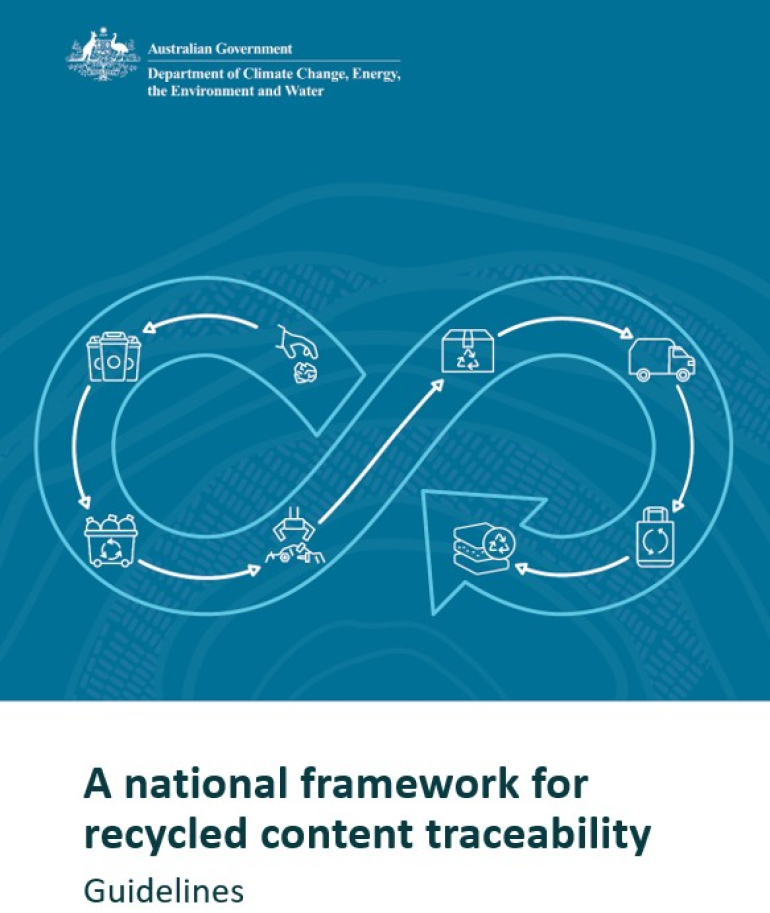
The Australian Government has released its National Framework Recycled Content Traceability for which the UNSW SMaRT Centre provided a detailed submission as part of the consultation phase.
Published at the end of 2025 by the Department of Climate Change, Energy, the Environment and Water, the Framework - also supported by the State and Territory Governments - aims to boost confidence in recycled materials, by guiding the collection and sharing of information about them.
The Government says "it enables Australian governments to set consistent expectations and supports industry to meet these."
"Australia's transition towards a circular economy relies on more recycled materials being used and keeping them in use for longer."
The new framework:
In its submission, SMaRT said: "The primary reason for this support is because there must be a start to standardise recycling content for manufacturing purposes. However, we do not believe a voluntary, industry-led process will achieve the desired goals of the scheme.
"This has been the experience with various product stewardship schemes which have been unable to deliver the rates of recycling and resource recovery needed. We believe a joint industry and government framework – but with clear regulatory guides and incentives – would help avoid inevitable delays and a lack of industry uptake. The proposed model of a single scheme administrator for the recently proposed e-waste and PV waste product stewardship, or something similar, would be generate a more optimal outcome. This proposed framework is rightly ambitious and involves various “moving parts”.
"Voluntary take-up without a stronger incentive, such as a regulation, would result in a piecemeal outcome with varying results and outcomes. The voluntary, industry led Red Cycle scheme comes to mind. The paper alludes to some of the European work in this area which is back by regulation. We would encourage the department to take a close look at this model, and any other similar ones, including the best aspects of Australia’s food traceability regime, to bolster the current framework.
"While we fully support the intent, in terms of application we believe there is a conflict between the stated approach that the 'framework is proposed to be technology-agnostic, outcomes-focused and initially voluntary' and the stated objective of it being 'industry-led interoperable traceability systems in use across recycled content supply chains providing accessible, accurate and harmonised recycled content data that drives greater use of recycled content in Australia'.
"A lot of criticism has been aired in recent times in relation to so called “green washing” in relation to ESG reporting. A key reason for this is due to the fact that there is a lack of regulatory definition and requirements with such reporting. Both carrot and stick are needed to unify stakeholders to make meaningful and importantly, consistent and collective change."