
Latest news
Read the latest news from the Centre for Sustainable Materials Research and Technology


A UNSW SMaRT Centre research study has found how to recover valuable metals (especially rare earth elements) from liquid waste streams such as mining tailings waste.
Published in Elsevier Science Direct's Separation and Purification Technology Journal, the study did not focus on using traditional chemical extraction processes - which can be complex, costly, and environmentally harmful - but a method called adsorption.
This works a bit like a sponge: a specially designed material is added to the liquid, and it selectively “sticks to” and captures the metal ions from the solution. Adsorption is widely seen as a promising alternative because it can be simpler, cheaper, and more environmentally friendly than other methods.
These metals are essential for modern technologies like electric vehicles, wind turbines, and electronics, but they are difficult and expensive to extract.
At the same time, a lot of these metals end up diluted in waste liquids from mining, recycling, or industrial processes. The study is trying to solve a key challenge: how to efficiently pull these metals out of liquid waste so they can be reused instead of lost.
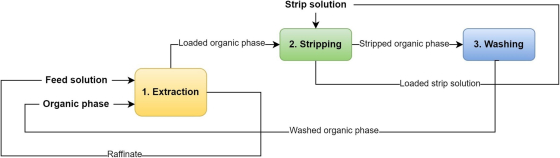
In the study, the team developed or tested advanced adsorbent materials designed to target specific metals in solution. They then exposed these materials to metal-containing liquids (which simulate real industrial or recycling streams) and measured how well the materials could capture the metals.
They also tested how different conditions - such as concentration, solution chemistry, and contact time - affected performance. This helps determine whether the method would work outside the lab.
The results showed that the materials were very effective at capturing metals from solution, even when the metals were present in low concentrations. This is important because many waste streams are dilute and hard to treat. The study also demonstrated that the materials could be made selective—meaning they can target specific metals rather than removing everything indiscriminately. Adsorption processes are known for this ability to selectively bind certain ions based on their chemistry.
Another important outcome is that the adsorbent materials can often be reused multiple times. After capturing the metals, the materials can be treated to release them (so the metals can be collected), and then used again. This makes the process more practical and cost-effective. Reusability is a key requirement for industrial adoption because it reduces both operating costs and waste generation.
This research is particularly useful for hydrometallurgical processing, which is the part of metal extraction that happens in liquids (after materials are dissolved using chemicals). These liquid streams are often complex and contain valuable metals that are currently difficult to recover efficiently. By improving how we capture metals from these streams, the study helps make recycling and refining processes more efficient and sustainable. Hydrometallurgy is already widely used for treating low‑grade ores and waste materials because it works at relatively low energy compared to high‑temperature methods.
Overall, the research shows that adsorption‑based methods could play a major role in the future of metal recovery. It provides new knowledge about how to design materials that can selectively and efficiently capture valuable metals from waste liquids. This is important because it supports a circular economy, where materials are reused instead of discarded, and it helps reduce the need for new mining. In simple terms, the study brings us closer to turning waste streams into valuable resources in a cleaner and more cost‑effective way.