
Latest news
Read the latest news from the Centre for Sustainable Materials Research and Technology


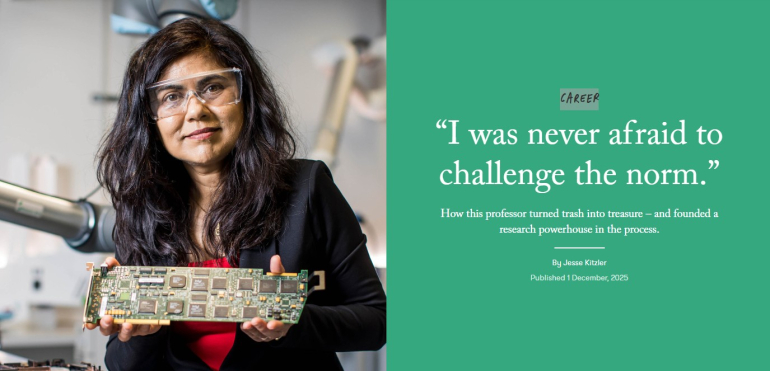
In part II of the UNSW SMaRT Centre's support of an IP Australia campaign helping all Australians protect the value of their ideas, IP Australia has published a feature story about SMaRT's waste and recycling technology innovation journey.
The campaign also has a specific objective of supporting women to make informed decisions about their unique and valuable intellectual property (IP).
Jointly run by the Future Women organisation, the "She Built This: Empowering women through IP" campaign features tips and tricks and inspiring stories, including the one below by Jesse Kitzler for Future Women, about the achievements by UNSW SMaRT Centre and its Director Prof Veena.
Feature story, by Future Women
Excerpt:
Professor Veena Sahajwalla AO doesn’t see waste the way most people do.
To her, used materials are not an afterthought, a byproduct of her experiments or something to be pushed out of sight. They’re her primary resource of choice.
And she wants us to think the same way.
“No one would have ever imagined that we could make products from waste that conform to performance requirements,” says Veena. “People assume that if it’s waste, it won’t be good – overcoming those challenges is part of the fun.”
An Australian Research Council Laureate Professor, materials scientist, engineer and inventor, Veena – nicknamed “The Queen of Waste” – is known for her pioneering work transforming waste into high-value materials.
Veena patented Green SteelTM Polymer Injection Technology (PIT) in 2003. This process sees used tyres from vehicles ground down to substitute a percentage of coal used in electric arc steel-making furnaces.
Considering steel-making accounts for roughly seven percent of human-caused greenhouse gas emissions, PIT, if used at scale, could be a revolutionary development for the industry and the planet.
“I heard all of these stories about waste tyres being such a big problem and with our Green Steel PIT, I saw a win-win solution for both the environment and the economy,” Veena explains.
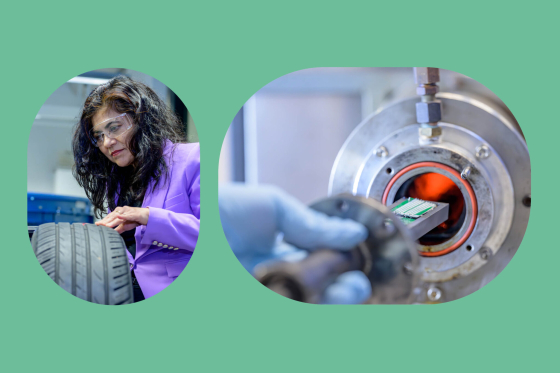
She says that growing up in Mumbai taught her how to be innovative with the limited resources and materials around her.
“I was always curious – but also a bit naughty. I was never afraid to challenge the norm knowing full well that there could be consequences.”
This disruptive streak has served Veena well.
She was appointed an Officer of the Order of Australia for her distinguished service to science in sustainability and waste management and, in 2022, she was named NSW’s Australian of the Year. Her scientific excellence has also been acknowledged through both an ARC Australian Laureate Fellowship in 2014 and an ARC Australian Industry Fellowship in 2024, along with numerous other prestigious scientific awards.
Since its invention, Veena’s Green Steel has been commercialised across Australia, Europe and Asia. This technology is responsible for repurposing millions of tyres and reducing emission rates across the industry.
And yet, Veena’s greatest success could have been her greatest loss, had she not caught herself from making a critical mistake.
“You might not necessarily think about patenting on day one but, looking back, you will certainly thank yourself for doing the IP work.”
A week before she was set to showcase Green Steel in a US conference, Veena realised the risk she was taking by presenting her ideas without first securing her intellectual property (IP).
“At that point, I thought it was too late,” said Veena. “I had to leave the country in a week to travel to the US, so I had to stop everything else to meet the provisional deadlines, but we made it happen.”
The University of New South Wales, where Veena works as a professor and founded the UNSW Sustainable Materials Technology and Research (SMaRT) Centre, engaged patent attorneys to guide her through the process.
She credits the “incredible commercialisation ecosystem at UNSW” for helping her to bridge the gap between in-lab innovations and industry-scale solutions.
“The funny thing is, every time I think about patenting something now, I say I’ll give myself more time considering I didn’t have that luxury the first time around. Safe to say that’s never happened since,” she says.
“You might not necessarily think about patenting on day one but, looking back, you will certainly thank yourself for doing the IP work.”
After patenting and completing industry trials for PIT, the next step was for Veena to commercialise the technology. While this progression can appear daunting, Veena believes it’s an exciting step in the inventor’s journey.
“Every time you commercialise something it feels like you’re doing it for the first time, which can actually be fun,” she says. “It never gets boring or stale.”
Her advice? Prepare to be agile.
“The rule book changes every time, depending on the partner, the product and the project.”
Veena now holds around 40 patents for a range of technologies that can reform various wastes into valuable feedstock for remanufacturing.
She’s achieved this by continuing to bring innovation to her existing inventions, rather than shelving them once patented.
Owing to Veena’s continued work improving PIT, wastes including plastics and coffee grounds have joined used tyres as alternatives to coal for steel making.
“It’s not just about us being in the lab, but talking about why we do what we do, and why it matters for the planet.”
Beyond safeguarding her ideas and inventions, she sees patenting as “a powerful way to bring a lot of new partners on board.”
Veena engages engineers, scientists, and research partners across industries, non-profits and governments. Together, they develop innovative environmental solutions for the world’s biggest waste challenges.
“We can do different things depending on what we’re really passionate about, but our vision and goal is common: coming together for the planet,” says Veena.
She says that the answers they’re looking for are often found not by tweaking at the edges, but by taking a radical approach.
“You look at a simple water bottle and say ‘What else can I do with it?’, then convert it into another water bottle,” says Veena. “By not taking a like-for-like approach, we broaden our realm of possibilities.”
“That’s the whole point of patenting – you’re thinking about something counterintuitively.”
Veena shares this outlook with the undergrad and postgrad students at the SMaRT Centre.
“We try to teach the skills that you learn for life. It’s not just about us being in the lab, but talking about why we do what we do, and why it matters for the planet,” she says.
“We want them to know how the experiment looks in the lab, but also how it manifests at a pilot level then industrial scale when moving towards commercialisation”.
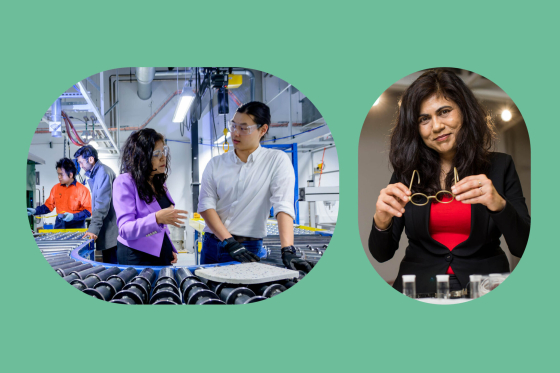
Her work at the SMaRT Centre has drawn attention from industries beyond manufacturing.
“We’ve had so many people want to visit us, I could be printing out tickets like it’s Disneyland,” jokes Veena. “We’re opening the doors to people from the construction and architecture space who are giving really positive feedback.
“I’ve never had an industry partner go, ‘Don’t bore me with your science.’ The fascination and genuine engagement is there. People want to feel connected to the story and the products they’re using.”
Turning an invention into a scalable solution, though, is no easy feat. Especially when your goal isn’t to mass produce – but to empower localised manufacturing.
Bigger doesn’t always mean better, according to Veena. She says that solutions need to match the size and skillset of the communities they serve.
“It’s not always about economies of scale. On many occasions, it can be about economies of purpose.”
To that end, Veena has developed and trade marked MICROfactorieTM Technologies– small-scale, decentralised facilities that enable communities to transform local waste into valuable products, materials and resources.
While this model rolls out across urban and rural communities across Australia, Veena is working to take MICROfactoriesTM global. Even the World Economic Forum has taken notice.
“If we adopt this new way of thinking and doing things, it will become the norm to show care for the planet and people,” she says.
For prospective inventors and founders, Veena believes persistence and flexibility are the recipe for success.
“Your passion and heart are what brought you to the table and what will keep you going,” she says. “Your head will teach you that there are a whole variety of different solutions that you could be exploring.
“Collectively, we can make a fabulous impact together.”
Excerpt:
It was not a good moment for Kodak.
In the early 90s, Polaroid sued the photography giant for allegedly infringing on no less than 12 of its patents. Consequently, Kodak was ordered to pay almost a billion dollars in damages to its competitor and, by 2012, had filed for bankruptcy.
The moral of this story? Neglecting intellectual property (IP) can cost you everything. And obtaining a patent could be what saves you from a similar fate.
This temporary legal and exclusive right to stop others from commercialising their invention allows innovators to protect their ideas, attract investment and gain a competitive edge in the market.
As part of our She Built This series, two Aussie founders share their patenting experiences and advice on the process – while another weighs whether a patent is the right move for her brand.
It was just over a week before Professor Veena Sahajwalla AO was set to unveil Green Steel – a first-of-its-kind steel made by recycling waste materials – at a US conference when she realised the risk of presenting her ideas without a patent in place.
“At that point, I thought it was too late,” said Veena. “I had to leave the country in a week to travel to the US, so I had to stop everything else to meet the provisional deadlines, but we made it happen.”
The University of New South Wales, where Veena is a professor, brought patent attorneys on board to guide her through the process.
“You might not necessarily think about patenting on day one but, looking back, you will certainly thank yourself for doing the IP work,” she says.
Today, Veena holds nearly 40 patents. Beyond safeguarding her ideas and inventions, she sees them as “a powerful way to bring a lot of new partners on board”.
“Every time you commercialise something it feels like you’re doing it for the first time, which can actually be fun,” she says. “It never gets boring or stale.”
Back in the 90s, around the time Polaroid sued Kodak, plastic surgeon Professor Fiona Wood AO and scientist Marie Stoner were taking healthy skin from burns patients, growing skin cells in their laboratory and spraying them on to wounds.
The result? Significantly better healing with less scarring. A truly remarkable, life-saving invention.
“And so we put in a provisional patent … but we made the mistake of doing it on the fly with the insight of a gnat,” says Fiona. “We didn’t understand the whole game plan.”
The process behind applying for this patent looked like cold-calling a lawyer and paying them a couple of thousand dollars to file it. Then it just sat there.
“We lost that first patent because we weren’t in a space where we understood the commercialisation process in a timely fashion,” says Fiona. “We had to come back to it when we’d done more work and we were more savvy.”
For their next attempt, the duo found a patent lawyer who would take them from start to finish.
“So that was our second bite of the cherry,” says Fiona. “It was much more comprehensive and thought out, with the right support in place – and that one actually stuck.”
The healthcare pioneer compares the process of patenting to competing in a marathon.
“More like an ultramarathon,” she adds. “I look at it now and I think, how did we do it? And I think we were incredibly stubborn and we didn’t know we couldn’t.”