Latest news
Read the latest news from the Centre for Sustainable Materials Research and Technology


A UNSW SMaRT Centre research study has demonstrated a novel method of recovering a rare earth metal from old batteries.
The rare earth feedstock was recovered from spent nickel-metal hydride (NiMH) batteries, an important electronic waste stream because very little recycling of batteries takes place, resulting in valuable materials being discarded.
Instead of mining fresh rare earth ores, the study Published in Elsevier ScienceDirect's Journal of Minerals Engineering, demonstrates a pathway for recovering high-value cerium from end-of-life batteries to directly enhance:
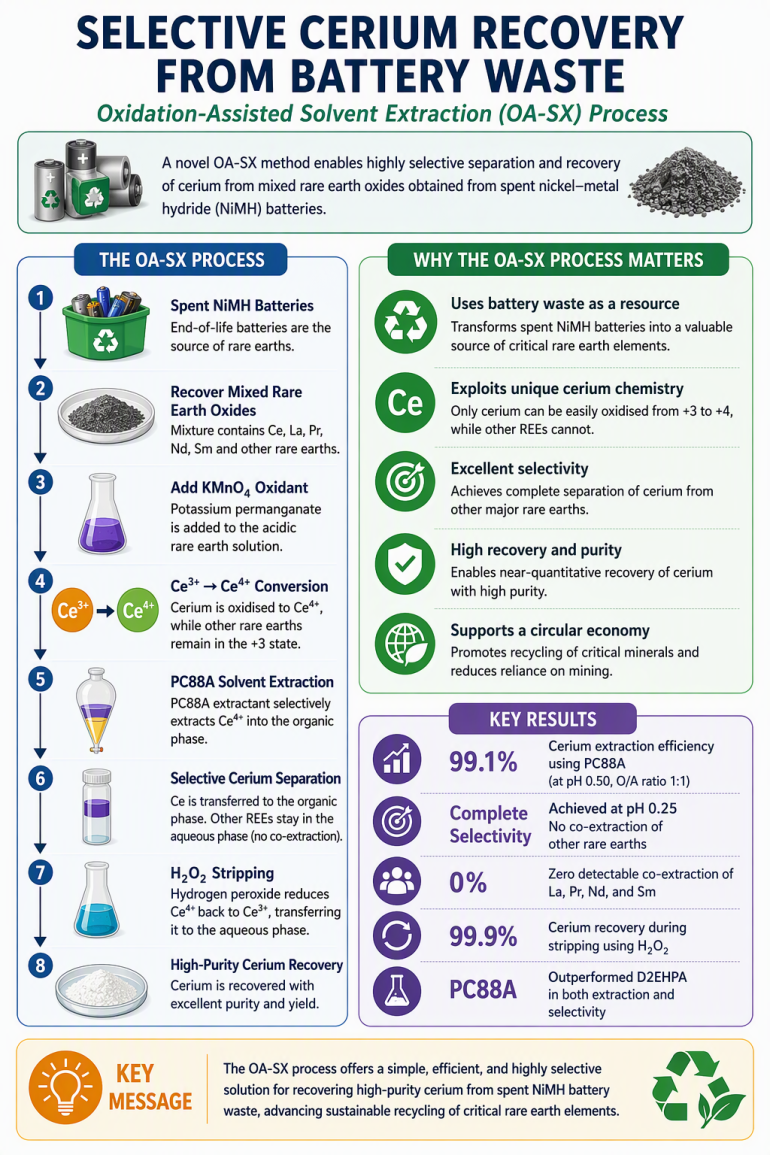
The SMaRT team developed a process called Oxidation-Assisted Solvent Extraction (OA-SX), able to achieve 99.1% extraction efficiency and 99.9% recovery, while completely preventing co-extraction of other major rare earth elements under optimized conditions.
The innovation was to combine oxidation – converting cerium from Ce³⁺ to Ce⁴⁺ using potassium permanganate (KMnO₄), with solvent extraction – separating the oxidised cerium into an organic phase while leaving most other rare earths behind.
This study provides a highly selective method for recovering cerium from battery waste by exploiting its unique oxidation behaviour. Compared with many conventional approaches, the process achieved:
Because cerium can exist in two oxidation states while most rare earths cannot, the researchers used this unique chemistry to achieve very selective separation.
Rare earth elements (REEs) are critical materials used in electric vehicles, batteries, magnets, catalysts, electronics, and renewable energy technologies. One of the biggest challenges in recycling rare earths is that they are chemically very similar, making them difficult to separate from one another.
As this infographic shows, this study focused on cerium (Ce), a valuable rare earth element found alongside lanthanum (La), praseodymium (Pr), neodymium (Nd), and samarium (Sm).