Latest news
Read the latest news from the Centre for Sustainable Materials Research and Technology


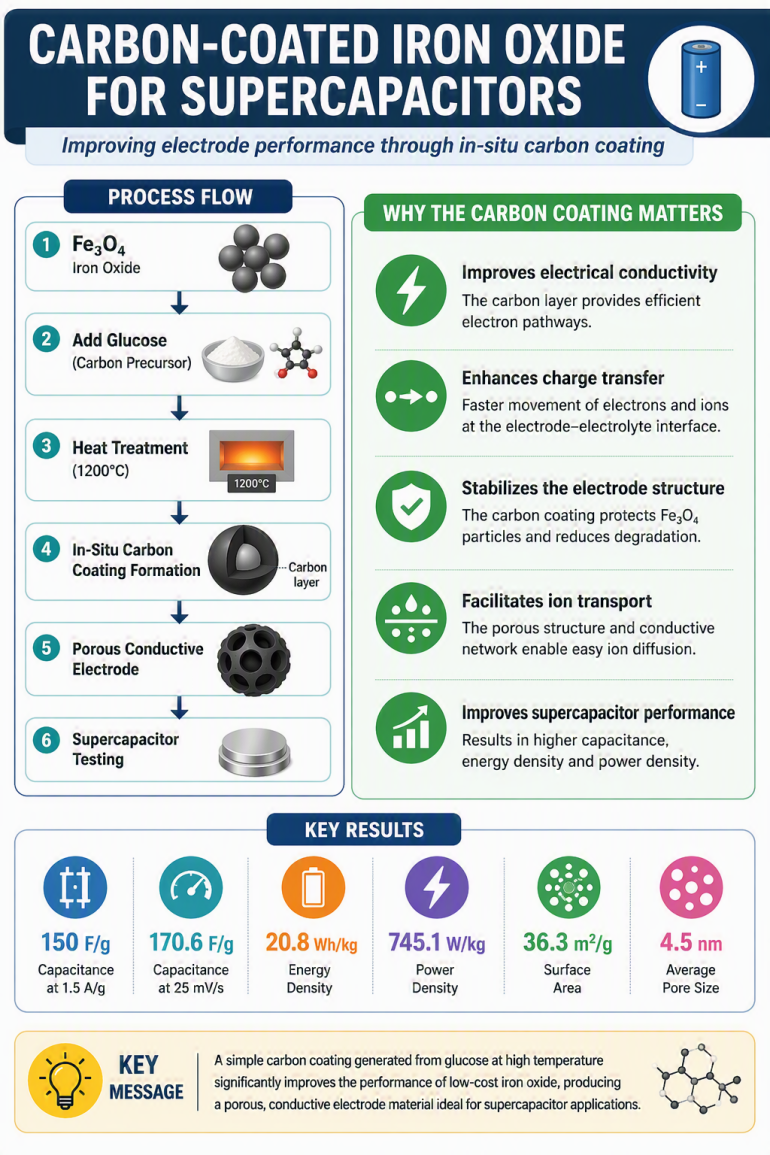
A UNSW SMaRT Centre research study has demonstrated that a simple carbon coating formed from glucose can transform low-cost iron oxide into a significantly more effective supercapacitor electrode.
Supercapacitors are attractive energy-storage devices because they can charge and discharge very quickly.
However, they need electrode materials that can store large amounts of charge while remaining stable over many cycles.
Iron oxide (Fe₃O₄) is cheap, abundant, and environmentally friendly, but it suffers from poor electrical conductivity and performance degradation.
The aim of this study was to improve iron oxide by coating it with carbon, creating a material called in-situ carbon-coated iron oxide (ISCC-Fe₃O₄).
The researchers investigated whether this composite material could be used as a high-performance supercapacitor electrode.
The team used glucose as a carbon source. During heat treatment at 1200°C, the glucose was converted into conductive carbon that formed a coating around the iron oxide particles.
This builds on SMaRT's growing body of work showing how various materials - particularly many wastes - not currently used can be effectively deployed to enhance energy storage.
This carbon coating was designed to:
Published in Elsevier ScienceDirect's Journal of Ceramics International, the study's laboratory analyses confirmed that carbon successfully coated the Fe₃O₄ particles and created a porous structure beneficial for electrolyte movement.
Why is this important? This study demonstrates a relatively simple way to improve the performance of a low-cost and abundant material.
The carbon coating provides:
The result is a more practical iron-oxide-based electrode that could support the development of affordable and scalable energy-storage systems
Key findings
Porous electrode structure; the material exhibited:
The porous structure allows electrolyte ions to move more easily through the electrode, improving performance.
Strong supercapacitor performance.
The carbon-coated iron oxide achieved:
Good energy and power density; the electrode delivered:
These values indicate that the material can both store useful amounts of energy and deliver it rapidly.
By coating iron oxide particles with carbon generated from glucose, the researchers significantly improved the material's conductivity and electrochemical performance, producing a promising low-cost electrode for future supercapacitor applications.
This work builds on the large body of work by SMaRT showing how sometimes simple, but new applications, of various materials, glucose in this case, and many materials derived from waste, can improve battery performance, as this infographic shows: