
Latest news
Read the latest news from the Centre for Sustainable Materials Research and Technology


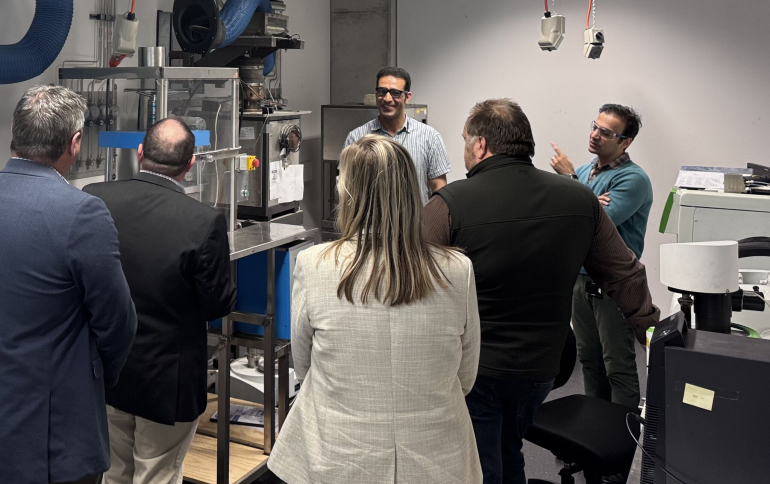
UNSW SMaRT Centre has been assisting the the Australian Parliament inquiry into the state of the Australian tyre industry in the context of a circular economy.
Members of the Parliament's Standing Committee on Industry, Innovation and Science Inquiry attended SMaRT recently as part of their Inquiry, learning about SMaRT researchers' various studies into tyre waste including its Green Steel Polymer Injection Technology which uses old tyres and other wastes as an alternative to coking coal in steel and iron making.
They also learned about ongoing tyre waste and circular economy work being undertaken by SMaRT and other partner researchers as part of the Sustainable Communities and Waste Hub that SMaRT and its Director Prof Veena Sahajwalla lead.
Veena, along with SMaRT's Dr Samane Maroufi, Dr Mohsen Hajian Foroushani and Dr Rasoul Nekouei, discussed research conducted by SMaRT and the Hub on transforming end-of-life tyres into valuable feedstocks for green steel production and other useful products, and treated visitors to a tour of the facilities.
They welcomed Committee Chair Mr Robert Mitchell MP, Member for McEwen in Victoria, and Deputy Chair Mr Pat Conaghan MP, Member for Cowper in NSW, along with staff members Liz Newberry and Adam Mara and Grace Cremen from the Committee’s support team.
Dr Hajian Foroushani later gave evidence at the Committee’s Sydney public hearing, sharing the research and practical opportunities to help Australia recover more value from waste tyres, as described in the detailed submission by the Department of Climate Change, Energy, the Environment and Water.
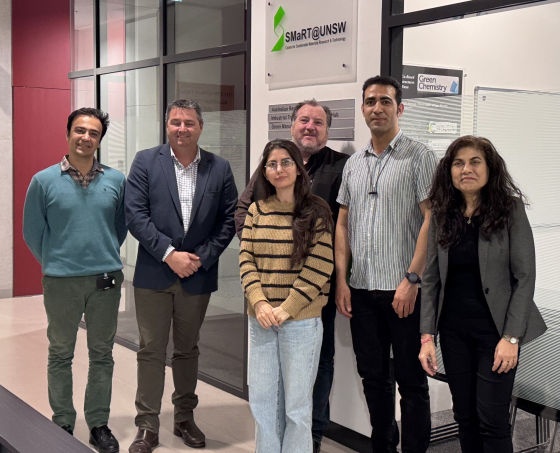
This follows earlier hub work by SMaRT researchers in developing a technology road map for decentralised recycling solutions.
The report, is part of a national research program to enable and encourage Australia’s transition to a circular economy.
The report says that in recent years, there has been an increasing emphasis on innovative recycling technologies that can significantly enhance the efficiency and effectiveness of recycling facilities. These technologies offer a promising avenue for improving recycling operations, reducing environmental impact, and fostering a circular economy.
This report is dedicated to the exploration and analysis of innovative recycling technologies specifically tailored for recycling facilities operating in regional and remote Australia. The unique challenges posed by these geographically isolated locations require specialised solutions to optimise resource recovery and minimise the environmental footprint.
This report provide comprehensive insights into the selection and deployment of various recycling technologies within these distinct contexts and report is structured into several key sections, starting with the criteria for selecting recycling technologies, followed by an examination of the technologies relevant to remote and regional Australia.
See details for SMaRT's very own MICROfactorieTM Technologies that use various, discreet modules to transform problematic waste materials, such as glass, textiles and plastics, into new value-added materials and products, such as engineered green ceramics for the built environment and plastic filament as a ‘renewable resource’ for 3D printing.
Recycling as a pivotal component of sustainable waste management, has evolved into a complex and multifaceted process. To comprehensively address the challenges and opportunitises associated with recycling in regional and remote Australia, it becomes imperative to dissect this process into distinct phases. These phases, namely Material Sorting, Component Dismantling, Size Reduction, Storage and Material Handling and Re-manufacturing, form the framework upon which this report is built.
Favouring re-manufacturing technologies that undertake measures to minimise material waste, curtail energy consumption, and efficiently utilise resources remains central to the ethos of sustainable resource management and cost-effectiveness.

Considerations extending to the scalability of the re-manufacturing process are indispensable. The technologies in question should exhibit adaptability across various production scales, ranging from small-batch re-manufacturing to extensive large-scale industrial operations.
Delving into an evaluation of the market demand for re-manufactured products constitutes a pivotal step in ensuring the commercial viability of products engendered by the chosen technology. A profound comprehension of consumer preferences and industry requisites assumes a pivotal role in the blueprint for a prosperous re-manufacturing venture.
By harnessing the power of innovative recycling technologies and adhering to well-defined selection criteria, recycling facilities in regional and remote Australia can contribute to a more sustainable future for the region, where waste is transformed into valuable resources and environmental stewardship is at the forefront of every endeavour.