Latest news
Read the latest news from the Centre for Sustainable Materials Research and Technology


A research study involving the UNSW SMaRT Centre has successfully reformed elements from waste glass and coffee grounds into a high value industrial material used for various abrasive products.
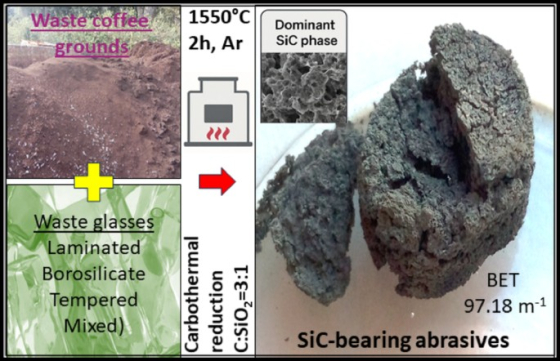
The Waste-to-Silicon Carbide study published in Springer Nature's Waste and Biomass Valorization Journal demonstrates that discarded coffee grounds and waste glass can be converted into a valuable silicon carbide material used in abrasives, cutting tools, wear-resistant products, filtration systems, and advanced engineering applications
The optimal mixture was 55% coffee-ground carbon and 45% glass-derived silica, producing a porous silicon carbide product suitable for abrasive and other advanced applications.
The work provides a practical example of circular economy thinking by turning two problematic waste streams into a high-value industrial material.
Overall, this study highlights two key outcomes: the development of a high-value abrasive material from neglected waste resources and the potential to reduce reliance on conventional raw materials.
Millions of tonnes of spent coffee grounds and waste glass are sent to landfill every year.
Coffee grounds generate greenhouse gases as they decompose, while much of the world's glass is still not effectively recycled. The researchers wanted to find a way to use both wastes as resources rather than treating them as rubbish.
Why is the product useful? Silicon carbide is a premium engineering material because it is:
The material produced in this study also had a high surface area (97 m²/g) and a well-developed porous structure, which could make it attractive for filtration, catalysis, energy storage, and environmental applications in addition to abrasive uses.
Researchers have previously made silicon carbide from agricultural waste, plastics, tyres, and rice husks. However, this study is one of the first to combine waste coffee grounds and waste glass as the carbon and silica sources.
This approach offers better control over the chemistry and uses two abundant waste materials that are commonly landfilled.