Latest news
Read the latest news from the Centre for Sustainable Materials Research and Technology


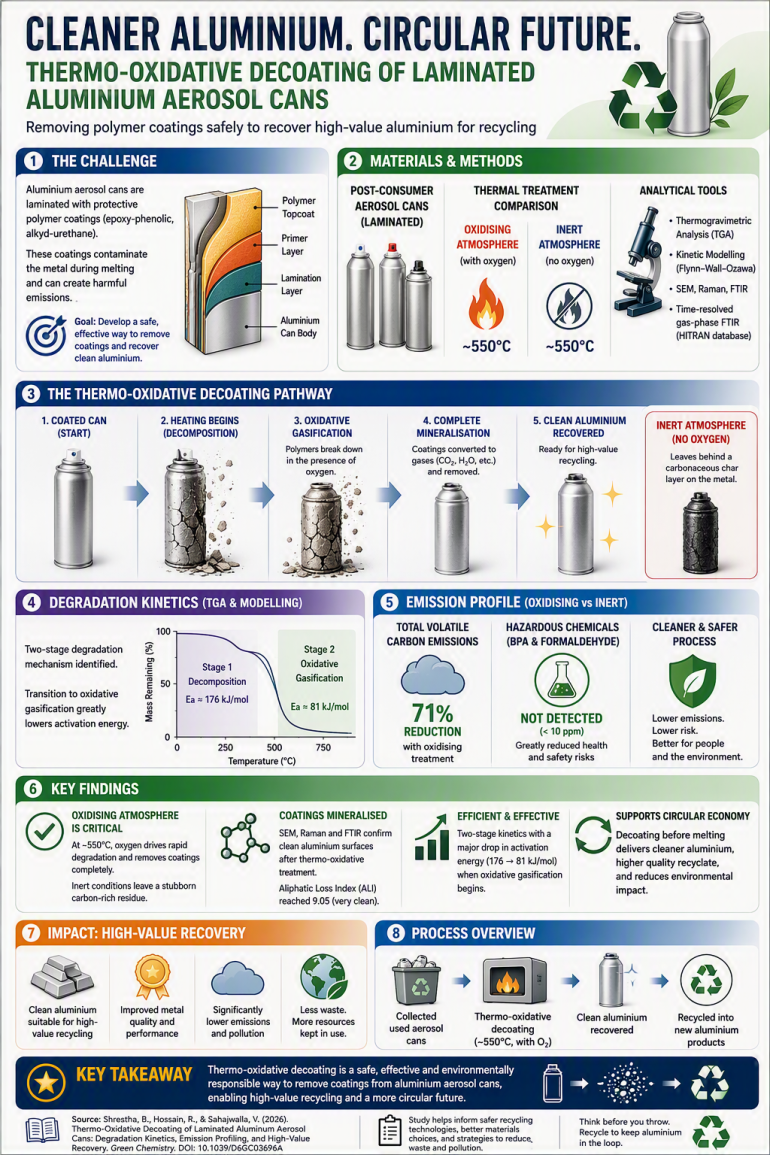
The UNSW SMaRT Centre has developed a process to safely and efficiently remove the polymer coatings and laminates attached to waste aluminium aerosol cans so that the underlying aluminium can be recovered and recycled at high value rather than downgraded and produce contaminants.
The SMaRT research, published in the Royal Society of Chemistry's Green Chemistry Journal, looked at viable ways to separate the plastic layering from the aluminium cans to prevent contamination and harmful emissions when melted down traditionally.
While the polymer coatings help protect the can during use, they often end up in landfill due to the difficulty in effectively recycling them . The researchers wanted to find a way to remove the coatings first so the aluminium could be recovered in a cleaner and more valuable form to enable efficient, sustainable recycling.
Using thermogravimetric analysis and kinetic modelling, the team tested what happens when the coated cans are heated under different conditions. They found that heating the cans in the presence of oxygen at about 550°C was very effective at breaking down and removing the plastic coatings.
When oxygen was not present, a layer of black carbon residue remained on the aluminium, making it harder to recover a clean metal product.
The researchers also closely monitored the gases released during the process to make sure it was safe. They found that the oxygen-based treatment reduced overall volatile carbon emissions by about 71%.
Just as importantly, they did not detect significant amounts of potentially harmful chemicals such as bisphenol A (BPA) or formaldehyde, which are often concerns when coatings break down.
Overall, the study showed that their thermo-oxidative decoating method is a promising recycling process for aluminium aerosol cans.
By removing the coatings before the metal is melted and recycled, the process produces cleaner aluminium, reduces pollution, and helps keep valuable materials in use for longer.
This supports a more circular economy where less material is wasted and more aluminium can be recycled back into new products.
Overall, the paper concluded that thermo-oxidative decoating provides an effective pathway for recovering clean aluminium from laminated aerosol cans.
By removing coatings before remelting, the process improves metal quality, reduces contamination, lowers hazardous emissions, and supports a more circular economy model for aluminium packaging.
The work demonstrates that careful control of temperature and oxygen availability can transform a difficult-to-recycle waste stream into a source of high-value recycled aluminium.