
Latest news
Read the latest news from the Centre for Sustainable Materials Research and Technology



UNSW SMaRT Centre Director Prof Veena was interviewed by Australian Highlights about innovative solutions to waste and sustainability challenges.
Veena also explains the SMaRT Centre's various recycling technologies that use waste as a resource for manufacturing, creating new products and a circular economy to help with decarbonisation efforts.
Australian Highlights is a podcast and feature story platform focussing on science and innovation.
(See story excerpt below)
Producer and host
Rachel Rayner, Science Explainer, is a science communicator, poet and performer who focuses on science storytelling and public interest.
She writes, produces and presents live shows, articles, poems, podcasts and educational workshops. Rachel has produced content for organisations such as Questacon—the National Science and Technology Centre, the Discovery Science and Technology Centre in Bendigo, the Ocean Exploration Trust on the E/V Nautilus, and CSIRO, Australia’s national science agency.
She has published poems in various journals and co-authored a paper on science poetry. Rachel also tours her live quantum comedies nationally to sold out audiences. In 2022, she won the Adelaide Fringe Festival’s Science at the Fringe Award with her first solo show, A Flying Photon.
A sudden trade war has nearly all of us thinking about the products and produce we need, want, consume, where they come from and what international relationships make them happen.
America is not the manufacturing powerhouse it was at the beginning of the 20th century. Neither is Australia.
Over the years, Australia’s industry has moved from agriculture (so many sheep) to manufacturing (think the Ford factories in Geelong) to a service economy. I’m pretty sure a wealthy businessman I met thought the service economy meant lots of call centres (he worked in textiles), but it’s more like having great doctors and surgeons, Universities that compete on the world stage, amazing culinary experiences, and all those consultants doing something…though we’re not sure what, exactly. Either way, it’s a service, not a physical product.
But perhaps we could be more. Professor Veena Sahajwalla is focused on the circular economy: a world where materials are not extracted from nature – be it underground, from forests, from oceans – but from our rubbish. Nothing is new, but everything is renewed.
Most of us know the three ‘Rs’ to help us cut down on waste: reduce, reuse, recycle. ‘Recycle’ as the term we know today came into use in the 1960s. It means to put resources back into the manufacturing system, reclaim the waste product to be converted again into something useful.
There’s a bit more than just the three Rs these days. There’s eight more Rs in this article by Cleanup Australia (rethink, refuse, refill, repair, resale, rent, repurpose, rot). For Veena, there is also ‘reform’ and ‘remanufacture’, in order to ‘renew’.
Veena’s work is all about how waste can become treasure. As a material engineer, she is looking deep into a waste product at the molecular level and imagining ways it can be reformed into something useful.
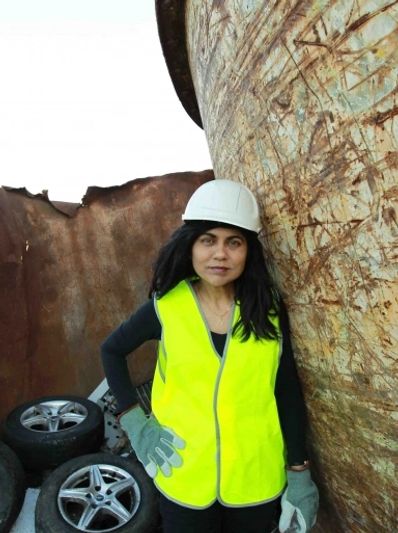
Her first invention is called “Green Steel”; a polymer injection into the steel making process that created the same, if not better, product but without using coal.
The process of creating steel involves extracting oxygen from the iron ore and adding carbon to it under extremely hot conditions. There’s more chemistry here than physics. Much of the industry uses coke (the coal kind, not the cola kind) as the carbon source for the iron.
When Veena was studying the process, she realised that all it needed was a rich source of hydrogen to draw the oxygen away from the iron, and carbon to bond with the iron. This didn’t have to come from energy-intensive coke, which is produced by heating coal in a specialised oven for nearly a day, it could come from something that nobody wanted.
Tyres can be retreaded to extend their life but at some point, they can no longer function safely as a tyre. They become a waste, dumped in huge piles. Or, as Veena discovered, they can be reformed as a vital component in the steel-making process. She turned the tyres into a hydrocarbon-rich polymer to be injected into a furnace, replacing the need to use coke.
As she says, “knowing a sector that produces all these important metals like steel, you don't want to be part of the problem. You want to be part of a solution.”
The 3Rs focuses on us as individuals to do the right thing. The truth is, responsibility needs to fall to big business to make positive changes in our world. From the latest National Waste and Resource Recovery report, municipal (household) waste contributes around 18% of Australia’s total waste. The rest is commercial, industrial, construction and demolition.
We should be impressed – 63% of the 75 million tonnes of rubbish produced across the country is recycled. But I reckon we’d all agree this doesn’t go far enough.
Veena’s latest work, and that of her colleagues at the SMaRT centre, are looking into shifting ‘business as usual’, by introducing small-scale remanufacturing. It comes back to looking at deeply at our waste products, their molecular composition, and thinking about how those elements can be rearranged into something renewed. I suppose that’s a basic law of physics – nothing created nor destroyed, just changing form. There are no new atoms in the Universe, they just keep reforming: hydrogen to helium, helium to carbon.
Her team have come up with the idea, and built, MICROfactories. These will take the waste products that can no longer be reused, and reform them into something entirely different.
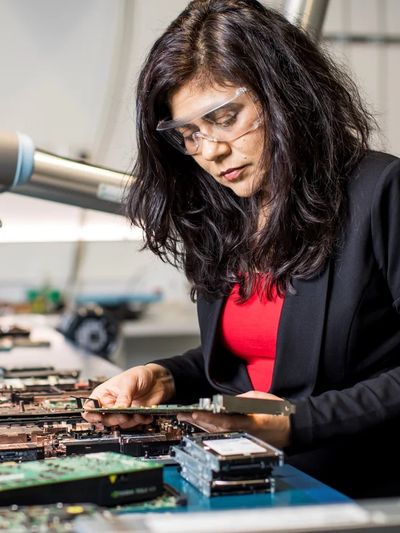
Images: Veena with a collaborator at RenewIT, holding the plastic filaments made from old printers.
The team with the ceramics MICROfactorie operated Kandui Technology in Cootamundra
Veena injects her polymer made from tyres into a molten iron ore slag.
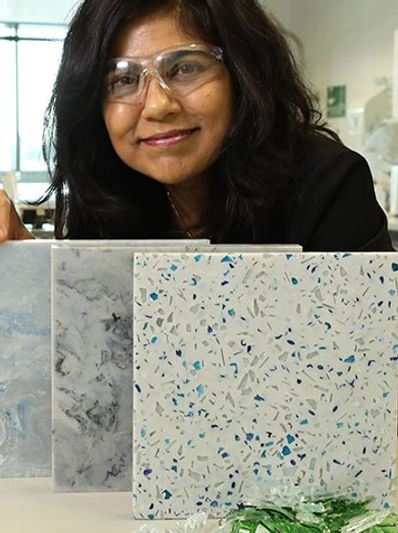
Veena with the final ceramic tiles.
What a grand idea. It’s not about making a lot. It’s about making enough.
The idea of a microfactory is that a community can manufacture – or remanufacture – the amount of items it needs. No more, no less.
Why do we push to scale? Why must companies only succeed if they make thousands and thousands of a single plastic bottle, to then sell across the world? Why not make just enough, to be bought, sold, reused, repaired, re-something else, locally?
It doesn’t work for everything, but it’s worth a momentary thought, a slight shift in perspective, an analysis of the objects around you right now.
Veena’s MICROfactories take up a shed and have many attachments. One, operating in Cootamundra, is making decorative, functional tiles from textiles and glass that can no longer be recycled. Another in Sydney is taking the plastic from old office printers and turning into feedstock for 3D printers.
These factories don’t churn out mountains of items. They make just enough.
This is an economy of purpose. It is also part of the circular economy, heading towards the zero-waste economy. It requires a reframing of everything we use and generate to figure out how these economies may work and how we can move towards them. After all, wouldn’t it be exciting if we didn’t “take out the rubbish” on Tuesdays, but, rather, we took out the resources for collection?
As Veena says from her work, it “gives you that kind of goosebumps moment when you start to go, oh my God, this could actually work.”