
Latest news
Read the latest news from the Centre for Sustainable Materials Research and Technology


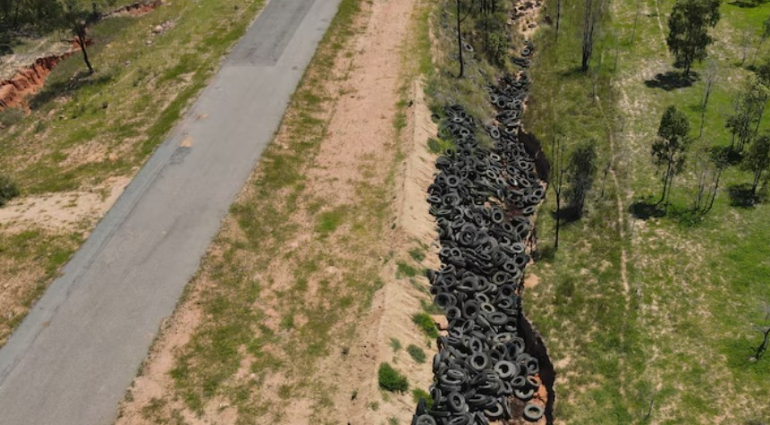
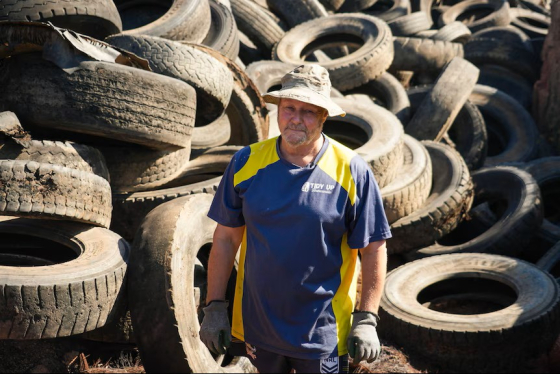
ABC News has published a feature story about the environmental harm caused by waste rubber tyres and the missed opportunity of their potential as feedstock for remanufacturing, such as via SMaRT's recycling technologies.
Image top and below: ABC News and Baz Ruddick.
ABC reporter Baz Ruddick, in his story entitled "Untouched illegal tyre dump sparks continued calls for legislation and innovation around recycling", reports that voluntary recycling of waste tyres isn't working and there should be regulations behind the nation's tyre stewardship scheme, a policy action also recommended by the UNSW SMaRT Centre.
Story excerpt:
Out of sight and out of mind in a ditch around an hour-and-a-half drive from Townsville, sits an illegal dump estimated to be holding close to 1,000 tyres.
Every year 540,000 tonnes of tyres reach the end of their use. While many are recycled or used as fuel for industrial projects overseas, a large proportion are simply dumped or stockpiled, both legally and illegally.
A national voluntary program is encouraging importers, retailers and recyclers to deal with tyres responsibly.
Lina Goodman, CEO of Tyre Stewardship Australia, says "rogue operators" who dump tyres illegally are common, and will typically take about $5 from a retailer for each tyre they promise to dispose of.
"The opportunity for someone to collect a tyre, pocket the money, and then dump them is really easy in Australia and we have got to make it stop," Ms Goodman said.
Professor Veena Sahajwalla is the director of the Sustainable Communities and Waste Hub at the University of New South Wales.
She said that typically people will think of recycling as a "like for like" conversion in which an end-of-use product becomes that product once again.
Materials scientist Professor Veena Sahajwalla says tyres contain elements that can be used in green steel manufacture. (ABC News: Patrick Thomas)
She believes that when broken down, tyres could have more diverse applications than just becoming rubber products.
"Tyres do contain fundamentally important elements like carbon and of course hydrogen. All of these are important elements that could well be applied in processing and making of green steel," Dr Sahajwalla said.
"Waste is really not a waste, it's a resource, and if it's a resource, you have to know how to harness that resource."
Rubber can replace coal and coke to provide carbon.
In the steelmaking process the rubber crumbs are injected directly into an electric arc furnace that liberates the carbon and hydrogen and allows them to perform metallurgical reactions.
Rubber crumbs can replace coal and coke as a carbon source when making steel. (Supplied: SMaRT@UNSW)
Dr Sahajwalla said markets needed to be "intentionally created" by working with industrial players.
"What we are talking about here really is about re-manufacturing," she said.
"It's not good enough to say, well, you know what, if we just collect something, if we just shred something, the market will just happen. We can't wait for market to just happen."