Latest news
Read the latest news from the Centre for Sustainable Materials Research and Technology


A UNSW SMaRT Centre research study has demonstrated a practical pathway for converting a common organic waste into a high-value advanced material.
Published in The Royal Society of Chemistry's Nanoscale Advances Journal, the study found that rather than treating spent coffee grounds as waste, they can become a feedstock for producing activated carbon suitable for energy-storage applications.
The work also shows that waste-derived activated carbon can outperform some commercial products, creating opportunities for:
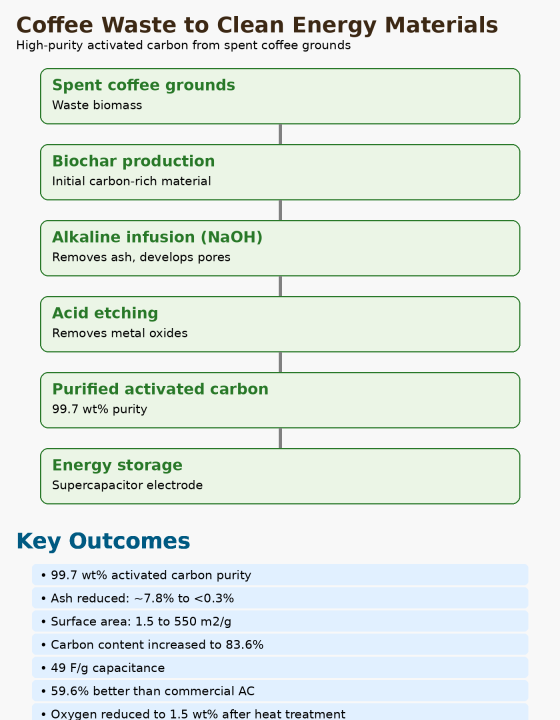
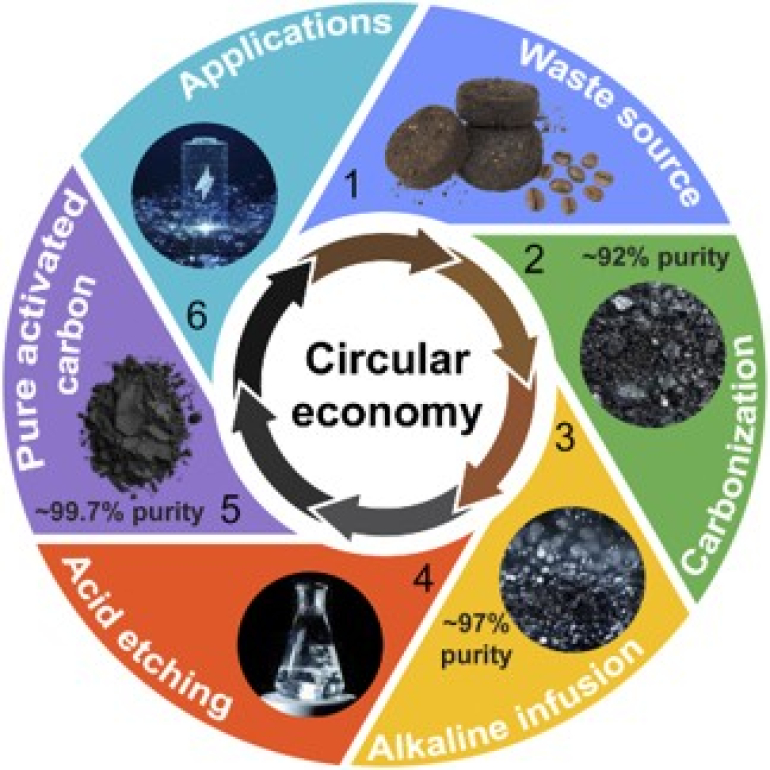
The study successfully transformed spent coffee grounds into ultra-high-purity activated carbon (99.7%), significantly improving material quality and achieving nearly 60% better energy-storage performance than commercial activated carbon, demonstrating a promising circular-economy pathway from coffee waste to advanced energy materials.
Every year, large quantities of spent coffee grounds are discarded as waste. At the same time, there is growing demand for high-purity activated carbon used in energy storage devices, water treatment, air filtration, and advanced manufacturing.
The researchers explored whether coffee waste could be transformed into a high-quality activated carbon that performs better than many commercial products while supporting circular economy objectives.
The team developed a scalable purification process involving:
The goal was to remove ash, metal oxides, and other impurities that can reduce the performance of activated carbon